The Future of Work in India by 2030: Skills, Jobs & How to Prepare
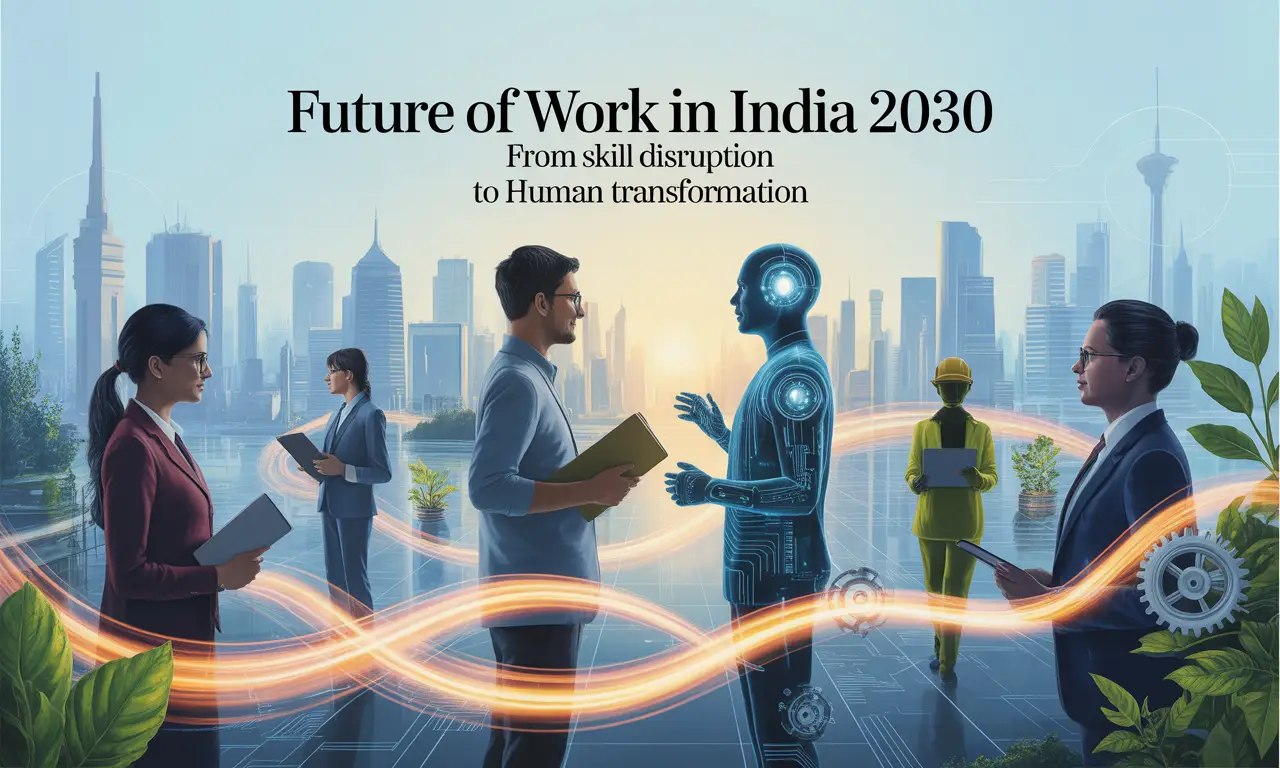
By 2030, India will be doing something no country has done at this scale: adding roughly 150 million people to its working-age population. At the same time, the work those people will do is being rewritten underneath them. Artificial intelligence, automation and the shift to a greener economy are changing what a job even is — not in some distant future, but across the next few years. The honest question for a student choosing a stream today, or a professional weighing a switch, is no longer "will there be jobs?" There will be. The real question is quieter and harder: will you be ready for the jobs that are actually coming? This article is a clear-eyed look at how work in India is changing by 2030 — which fields are growing, which are fading, the skills that will keep their value, and how you can prepare for it deliberately rather than by luck.
In short: By 2030 the great majority of Indian jobs will not disappear — they will change. Routine, rule-based work (data entry, basic clerical and compliance tasks) shrinks, while demand rises in AI and data, green and climate roles, healthcare, and any work that blends human judgement with technology. The skills that keep their value are the ones machines do not replace — analytical thinking, adaptability, communication and the ability to work alongside AI. The biggest risk for young Indians is not automation; it is choosing a career direction without understanding where the work is heading — which is exactly what informed guidance and a clear self-assessment are for.
Work Is Not Vanishing — It Is Being Rewritten
It is easy to read the headlines about AI and conclude that jobs are simply disappearing. The reality on the ground in India is more specific, and more useful to plan around. Studies of the Indian workforce suggest that a very large share of existing roles will change in some meaningful way this decade, as AI tools, automation and new technologies get absorbed into everyday work. "Change," though, is not the same as "vanish." A bank job still exists, but the person doing it spends less time on manual reconciliation and more on advising customers. A marketing role still exists, but it now assumes you can work with analytics and AI tools. The task mix moves; the job title often stays.
That distinction matters enormously for a sixteen-year-old choosing subjects or a thirty-year-old considering a pivot. The goal is not to chase whatever sounds "future-proof" this year, but to understand which kinds of work are growing, which are quietly shrinking, and where your own strengths and personality fit inside that shift.
The Forces Reshaping Indian Work by 2030
Five forces, pulling together, explain most of what is happening:
- AI and automation moving into the mainstream. A growing number of Indian companies are building AI into their workflows. The first tasks to move are the repetitive, rule-based ones; the work that stays human is judgement, interpretation and dealing with people. The result is not fewer workers so much as a higher bar — the same roles now expect comfort with data and digital tools.
- The gap between access and application. India has crossed the hard part of the digital divide — most households now have a smartphone. The new divide is what they do with it: a device used mainly for entertainment is very different from one used to learn a skill or explore a career. The advantage in 2030 goes to those who turn access into application.
- The green economy. As India invests in renewable energy, electric mobility and sustainability, a whole category of "green-collar" work is opening up — from solar and wind to water technology and waste management — that barely registered on career maps a decade ago.
- A young workforce, unevenly prepared. India's greatest asset is its youth — the median worker is strikingly young. But formal skilling still reaches only a small fraction of them. Left unguided, the "demographic dividend" can quietly become a demographic drag; guided well, it is the engine of the next two decades.
- A change in what people want from work. Younger Indians increasingly weigh purpose, flexibility and meaning alongside pay, and are more open to hybrid and portfolio careers than the strictly linear job ladders of the past. Work is becoming something you design, not just something you find.
Which Roles Grow, Which Fade
You do not need a crystal ball to plan sensibly — the direction of travel is already clear. Broadly:
- Growing: AI, data and analytics; healthcare and allied health; renewable energy and climate-linked roles; digital and product roles across every industry; and skilled trades and technologies that automation supports rather than replaces.
- Holding steady but changing: finance, management, teaching, design, law and most professional fields — the work continues, but it increasingly assumes digital fluency and the ability to use AI as a tool.
- Shrinking: narrow, routine, rule-based work — manual data entry, repetitive clerical and back-office tasks, and jobs whose entire value was doing the same predictable thing over and over.
The practical lesson is not "avoid these fields" but "do not build a whole career on the routine slice of any field." Within almost every sector, the safer and more secure ground is the part that needs a human — analysis, relationships, creativity, judgement.
The Skills That Keep Their Value
When employers are asked which skills are rising, the same themes recur — and notably, most are human rather than purely technical: analytical and critical thinking, adaptability and continuous learning, communication, creativity, and increasingly "AI fluency" — the ability to work with AI tools rather than in competition with them. The skills losing value are the mechanical ones a machine now does faster.
There is a reassuring truth buried in that list. The abilities that compound over a lifetime — how you think, how you learn, how you work with others — are exactly the ones technology cannot copy. Which means the smartest preparation is not memorising a list of "hot jobs," but building the durable strengths that let you move as the map keeps changing. Contact GCL's Career Advisor
The Real Risk Isn't Automation — It's Choosing Blind
Here is the part that gets missed. For most Indian students and early-career professionals, the danger this decade is not that a robot takes your job. It is that you choose a direction — a stream, a degree, a first role — without any real understanding of where the work is heading or whether it fits you, and then spend years correcting a decision made at seventeen with almost no information. In a world where the ground shifts every few years, choosing blind is the expensive mistake, not automation.
This is why career awareness and honest self-knowledge have quietly become survival skills. Knowing what you are genuinely good at, what you actually enjoy, and how those map onto a changing economy is no longer a "nice to have" — it is the difference between riding the shift and being caught out by it.
How to Prepare — Deliberately, Not by Luck
Preparing for 2030 looks different depending on where you stand, but the principle is the same: start from a clear understanding of yourself, then map that onto where work is going.
If you are a student (Class 8 to college): treat the decision as career design, not a one-time career choice. Begin with a genuine self-assessment — your interests, your strengths, your abilities and your personality — and explore widely, well beyond the handful of "default" careers everyone names. Keep building digital and thinking skills alongside your subjects, and treat learning as a portfolio you grow, not a box you tick.
If you are a working professional: the move is from "managing tasks" to building skills that carry across roles and industries. Audit which parts of your current work are becoming automatable and which are becoming more valuable, and invest deliberately in the second. A mid-career pivot is far less risky when it is based on a clear read of your transferable strengths than when it is a leap in the dark.
In both cases, the honest first step is the same — and it is genuinely hard to do alone. A scientifically proven career assessment measures your interests, strengths, abilities and personality, and maps them against the careers and skills that are actually growing, so your plan is grounded in evidence rather than guesswork or pressure. That is exactly what our career guidance programs at Global Career Labs are built to do, with a senior career counsellor to help turn the result into a concrete, future-ready plan you can act on and walk. In a decade defined by change, that clarity is the real advantage.
The Human Edge
It is worth ending where the anxiety usually starts. Machines are taking over tasks — but not purpose, not meaning, not the judgement to know why a piece of work matters. The future of work in India is not AI versus humans; it is AI alongside humans who understand themselves and their direction well enough to use it. The competencies that will define the next decade — clear thinking, creativity, working across cultures, resilience, and fluency in working with AI — are all deeply human. They can be built. And the earlier you start building them on a foundation of genuine self-knowledge, the more the change ahead works in your favour rather than against you.
Frequently Asked Questions
Which job is best for the future in India by 2030?
Fields expected to grow include AI and data, green energy, healthcare, cybersecurity, and skilled digital and care roles. The best job is one in a growing field that also matches your strengths — and a field you can keep learning in.
Which jobs will be available in 2030?
Jobs will still exist across most sectors, but their shape changes — expect strong demand in technology and data, healthcare and care work, green energy, logistics, education and skilled trades, and in roles that combine people skills with technology. Routine, rule-based work is the most likely to shrink.
Why are Gen Z struggling to get jobs?
Many young Indians face a gap between what degrees teach and what employers need — practical, job-ready skills, communication and experience — while automation is reshaping entry-level work and competition for good first jobs is intense. Those who do better choose a field on aptitude, build real skills early and keep learning.
Which skill is in high demand in the future in India?
Consistently cited skills include AI and data literacy, digital and cloud fluency, cybersecurity, and the human skills — critical thinking, communication, adaptability and problem-solving — that technology cannot replace. The most future-proof profile pairs a technical skill with strong human skills.
How many Gen Z are unemployed in India?
Unemployment among young Indians is markedly higher than the overall rate, and it is highest among educated youth who struggle to find jobs that match their degrees — a sign of a skills gap as much as a jobs gap. Figures vary by survey and year (official data comes from the Periodic Labour Force Survey), so treat any number as indicative.
Which jobs will be removed by AI?
The most exposed are highly repetitive, rule-based roles — routine data entry, basic bookkeeping, simple customer-support scripts, and parts of back-office IT and manufacturing. Even here, AI often removes tasks rather than whole careers, shifting people towards oversight and higher-value work. Roles needing judgement, empathy or creativity are the least affected.
Preparing, With a Little Help
The future of work in India by 2030 rewards one thing above all: knowing yourself well enough to move deliberately as the ground shifts. A scientifically proven career assessment gives you an honest picture of your interests, strengths, abilities and personality, and a one-to-one session with a senior career counsellor from Global Career Labs turns it into a clear, future-ready plan. Explore it through our career guidance programs. The aim is simply to help you prepare for the work that is actually coming — on the strength of evidence, not guesswork.
Related Readings
- Futuristic Careers: 21 Future-Ready Fields for 2030
- Courses After 12th: Options Across Every Stream
- Best Career Options After 12th
- How to Choose the Right Career After 12th
- Career Guidance in India: Help at Every Stage