Government Jobs in India: A Complete Guide to Exam Preparation and Success Routes
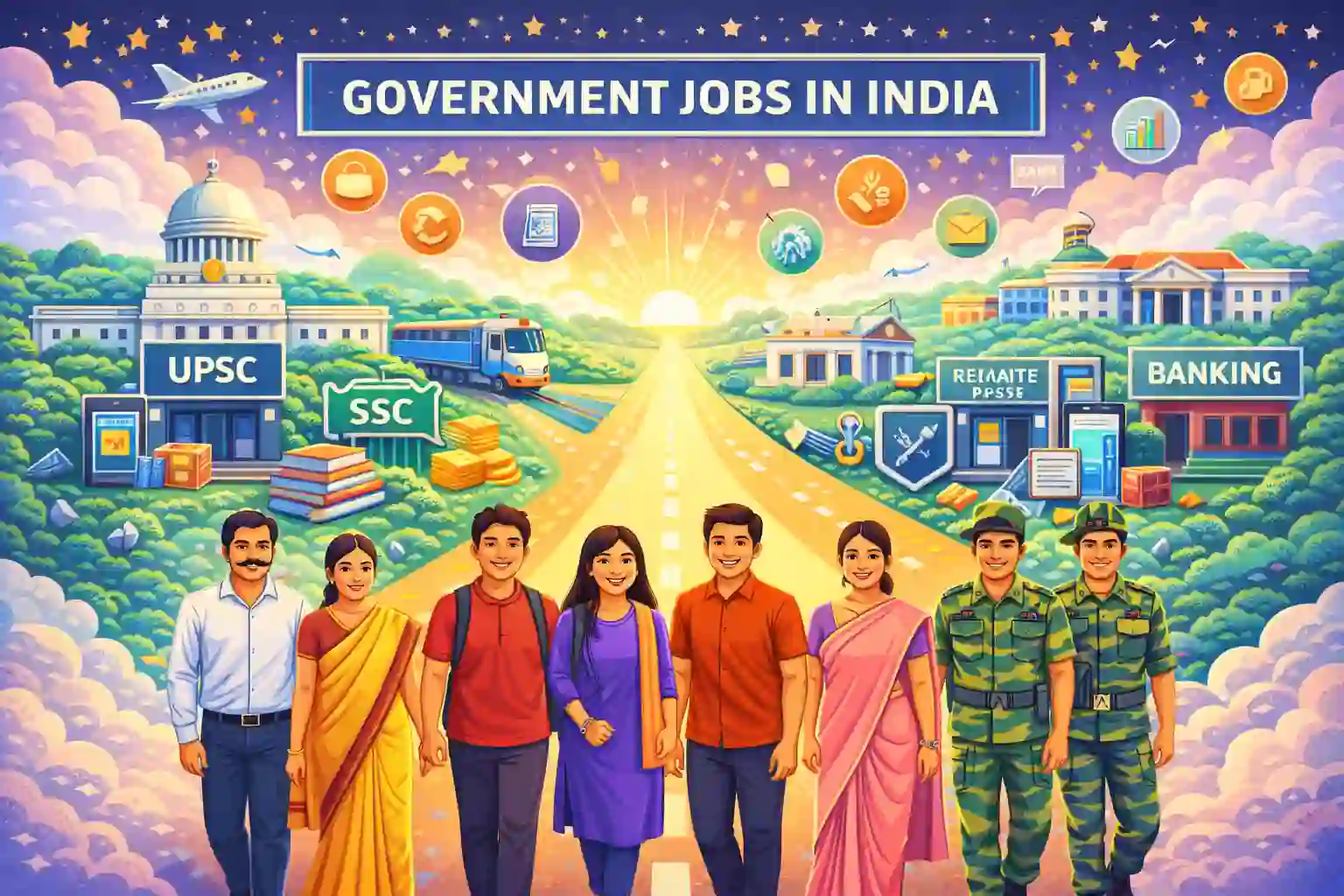
In most Indian families, the words sarkari naukri carry a weight that few private jobs ever match. A government job is shorthand for stability — a steady income, a pension, and a certain standing in the community that survives every economic downturn. Each year, crores of applicants sit for these exams, and the competition is genuinely fierce. This guide maps the full landscape of government jobs in India — the routes, the exams, who each one suits — and, just as honestly, helps you judge whether this path is the right one for you.
Because that second question matters. A government job is an excellent fit for many people and a poor fit for some, and the difference is worth understanding before you commit a year or more to preparation.
Why Government Jobs Pull So Many — and Who They Really Suit
The appeal is easy to understand. A government post offers security that is rare elsewhere: your role does not vanish in a bad quarter. Pay is structured and predictable, set by the national pay matrix rather than by negotiation, with allowances such as DA and HRA on top. Working hours are usually fixed, retirement benefits are real, and in most communities the respect that comes with the role is its own reward.
But it is worth being clear-eyed too. These exams are highly competitive, and preparation often takes a year or more of focused study — time with a real opportunity cost. Postings, especially in central services, can send you far from home. Growth tends to be steady rather than steep. None of this is a reason to avoid a government career; it is a reason to enter it deliberately. If you value stability, structure and public service over rapid pay jumps and you are willing to prepare seriously, a government job is one of the most rewarding paths in the country. If you thrive on fast change and quick advancement, it is worth weighing honestly against the private sector before you begin.
Three Myths Worth Dropping
A few persistent beliefs push people towards the wrong decisions. It is worth clearing them early.
- "A government job means an easy life." Some roles are genuinely relaxed; many — in administration, policing, banking or the railways — are demanding, with real responsibility and long days. Choose for the work, not for an imagined ease.
- "You cannot clear these exams without expensive coaching." Coaching can help, but every year a large share of successful candidates get there through disciplined self-study using official syllabi and free resources. A clear plan matters more than a fee receipt.
- "Any government job is better than any private one." Security is real, but so is fit. A role that leaves you unengaged for thirty years is not a bargain. The strongest choice is a government career that also suits how you like to work.
The Main Routes into Government Service
"Government job" is really an umbrella over several distinct sectors, each with its own recruiting body and exam. Here is how the main routes break down.
Civil Services & Central Government Posts
At the top sit the civil services — the IAS, IPS, IFS and allied services — recruited through the UPSC Civil Services Examination, a three-stage process of Prelims, Mains and a personality test. It is open to graduates, is famously demanding, and rewards sustained, structured preparation over one to two years. Below it, a very large share of central-government hiring runs through the Staff Selection Commission (SSC) — CGL for graduate-level posts, CHSL for 12th-pass roles, and MTS for entry-level positions. For a detailed look at the central-government structure, ranks and departments, see our dedicated guide to central government jobs.
Banking & the Public-Sector Banks
Public-sector banking is one of the most popular routes for commerce and general graduates. The IBPS exams recruit Probationary Officers and Clerks across most public banks, while the State Bank of India runs its own PO and Clerk drives. The work suits those comfortable with numbers and customer-facing roles, and advancement to managerial levels follows a clear, time-bound path.
Indian Railways
The Railways remain one of the largest employers in the country, hiring across a huge range of posts through the Railway Recruitment Boards (RRB) — the NTPC exam for posts like Station Master and Goods Guard, the ALP exam for Loco Pilots, and Group D hiring for track and support roles. Because the qualification bar spans 10th-pass to graduate, railways open a door for almost every education level. Our guide to railway jobs covers the exams and roles in depth.
Defence Services
For those drawn to service in uniform, the NDA exam (via UPSC) admits candidates straight after 12th into the Army, Navy and Air Force, while the CDS exam recruits officers from graduates. The Agniveer scheme offers a four-year enlistment route into the armed forces. Beyond the pay, defence careers carry a distinct set of benefits and a standing that many rank above every other government role.
PSUs & Engineering Roles
Engineering graduates have a strong, often-overlooked route through the Public Sector Undertakings — ONGC, BHEL, NTPC, IOCL and others — most of which recruit through the GATE score. UPSC's Engineering Services Examination (ESE) selects engineers for senior technical posts in government departments, and SSC JE recruits junior engineers. Research bodies such as ISRO and DRDO hire directly for their own projects.
Teaching & State Government Jobs
Government teaching posts — through KVS and NVS centrally, and state education boards regionally — require clearing the CTET or a state TET, and offer a genuinely balanced working life. Separately, every state runs its own Public Service Commission (UPPSC, MPSC, BPSC and the rest) recruiting officers, teachers, police and clerical staff who work within their home state — the natural choice for those who want to build a career close to family.
Government Job Exams: A Quick Reference
Most of the routes above are gated by one main exam. Notification windows shift a little each year, so always confirm on the official portal — but knowing the map early lets you aim your preparation at the right target from the start.
| Exam | Sector / posts | Conducted by | Minimum qualification |
|---|---|---|---|
| UPSC CSE | IAS, IPS, IFS & allied services | UPSC | Graduate |
| SSC CGL | Graduate-level central posts | SSC | Graduate |
| SSC CHSL | Clerical / 12th-level central posts | SSC | Class 12 |
| SSC MTS | Entry-level support posts | SSC | Class 10 |
| IBPS / SBI PO & Clerk | Public-sector banking | IBPS / SBI | Graduate |
| RRB (NTPC / ALP / Group D) | Indian Railways | RRB | Class 10 to Graduate |
| NDA | Defence — officer entry after 12th | UPSC | Class 12 |
| CDS | Defence — officer entry after degree | UPSC | Graduate |
| GATE | PSUs & engineering posts | IITs / IISc | Engineering degree |
| CTET / State TET | Government teaching | CBSE / States | D.El.Ed / B.Ed |
| State PSC | State-government officer & other posts | State PSCs | Varies |
Entry Points by Qualification
One of the real strengths of the government sector is that there is a genuine entry point at almost every stage of education.
- After Class 10: SSC MTS, several Railway Group D posts, and some state constable roles are open to 10th-pass candidates.
- After Class 12: SSC CHSL, the NDA for a defence-officer career, RRB NTPC posts and state police recruitment are all reachable straight after school — a strong reason to start planning early rather than waiting until after a degree.
- After graduation: the widest field opens up — UPSC Civil Services, SSC CGL, IBPS and SBI banking, state PSC officer posts, and GATE-based PSU roles for engineers. Your degree subject can quietly help here: commerce graduates, for instance, often do well in banking and audit-linked posts.
How to Prepare — Honestly
The preparation for government exams is a marathon, and treating it like one is what separates those who clear from those who repeat. Start by studying the exact syllabus and past papers of your target exam — not a generic reading list — so every hour is aimed. Build the fundamentals before chasing advanced questions, keep a steady daily rhythm rather than cramming in bursts, and make current affairs and regular mock tests non-negotiable parts of the routine. Consistency over months beats intensity over days.
One honest piece of advice: fix a realistic number of attempts and a timeline before you begin, and keep a parallel plan alive. Many strong candidates spend years on a single exam with no backup; a clear cut-off and a Plan B protect both your finances and your confidence. If you are choosing your degree with government exams in mind, our guide to career guidance for young professionals can help you align the two.
A Word on Pay and Benefits
Government pay is set by the Central Pay Commission's pay matrix rather than by individual bargaining, which is part of what makes it predictable. On top of basic pay come allowances such as Dearness Allowance and House Rent Allowance, along with medical cover, and — for many older-scheme employees — a pension. The 8th Central Pay Commission has now been constituted and is gathering inputs from employee associations, with its recommendations expected to shape the next revision. Exact figures vary by post, level and city and change with each revision, so treat any single number you see online as indicative and verify pay bands on the official notification for the specific post you are targeting.
Frequently Asked Questions About Government Jobs
Which government job is best in India?
There is no single best — it depends on your qualification and what you value. For top administrative authority, UPSC Civil Services (IAS, IPS, IFS) is the most sought-after; for strong pay with large annual vacancies, bank PO (IBPS and SBI) and SSC CGL Group-B posts are popular; after 12th, SSC CHSL, the NDA and railway posts are solid entry points. The best job is the one whose actual work, location and preparation load fit you — not simply the one with the highest profile.
Which government exam is best after graduation?
There is no single best exam after graduation — it depends on your interest and the effort you can commit. High-value options include UPSC Civil Services (the toughest and most prestigious), the banking exams (IBPS and SBI PO, RBI Grade B and Assistant), SSC CGL for central-government posts, and RRB and state-PSC exams. The best one is where your aptitude, the syllabus and the role genuinely fit — not simply the toughest name.
Which exam in India has no age limit?
A few have no upper age limit — most notably UGC NET for Assistant Professor eligibility, and professional qualifying exams such as CA, CS and CMA. Most mainstream recruitment, though — SSC, UPSC Civil Services, banking and railways — does set an upper age limit, with statutory relaxations for SC/ST, OBC, PwD and ex-servicemen candidates. Since the rule differs for every post, confirm it on the official notification.
What are the current government jobs in India?
Vacancies change constantly — central recruitment runs through bodies like UPSC, SSC, the Railway Recruitment Boards, IBPS for banks and the defence services, alongside state public service commissions. The Employment News and each recruiter's official website list current notifications with dates and eligibility, so check there rather than relying on third-party lists.
Which exam is easy to get a government job?
No government exam is truly easy, because competition is high everywhere, but exams for entry-level posts — such as SSC MTS, SSC GD, railway Group D and state-level clerical posts — have simpler syllabi than officer-level exams. The right one is the exam whose eligibility and syllabus match you, prepared for steadily.
Which is the 7 toughest exam in India?
Exams commonly described as among India's toughest include the UPSC Civil Services Examination, JEE Advanced, GATE, the CA final, NEET-PG, CLAT and UGC-NET, largely because of vast syllabi and intense competition. How tough an exam feels depends on the candidate, so pick the one that matches your goal and strengths.
A Note on the Figures Here
Vacancy numbers, eligibility rules, pay bands and exam dates change every year and vary by post and state. Everything above is a general starting point — always confirm the current details on the official recruiting-body portal (UPSC, SSC, IBPS, the RRBs and your state PSC) before you act on them.
Related Reads
- Central Government Jobs: Ranks, Departments & Exams
- Railway Jobs in India: Exams & Roles
- Courses After 12th: 100+ Options Across Every Stream
- Career Guidance for Young Professionals