Career Options After 12th Science: Finding Your Right Path
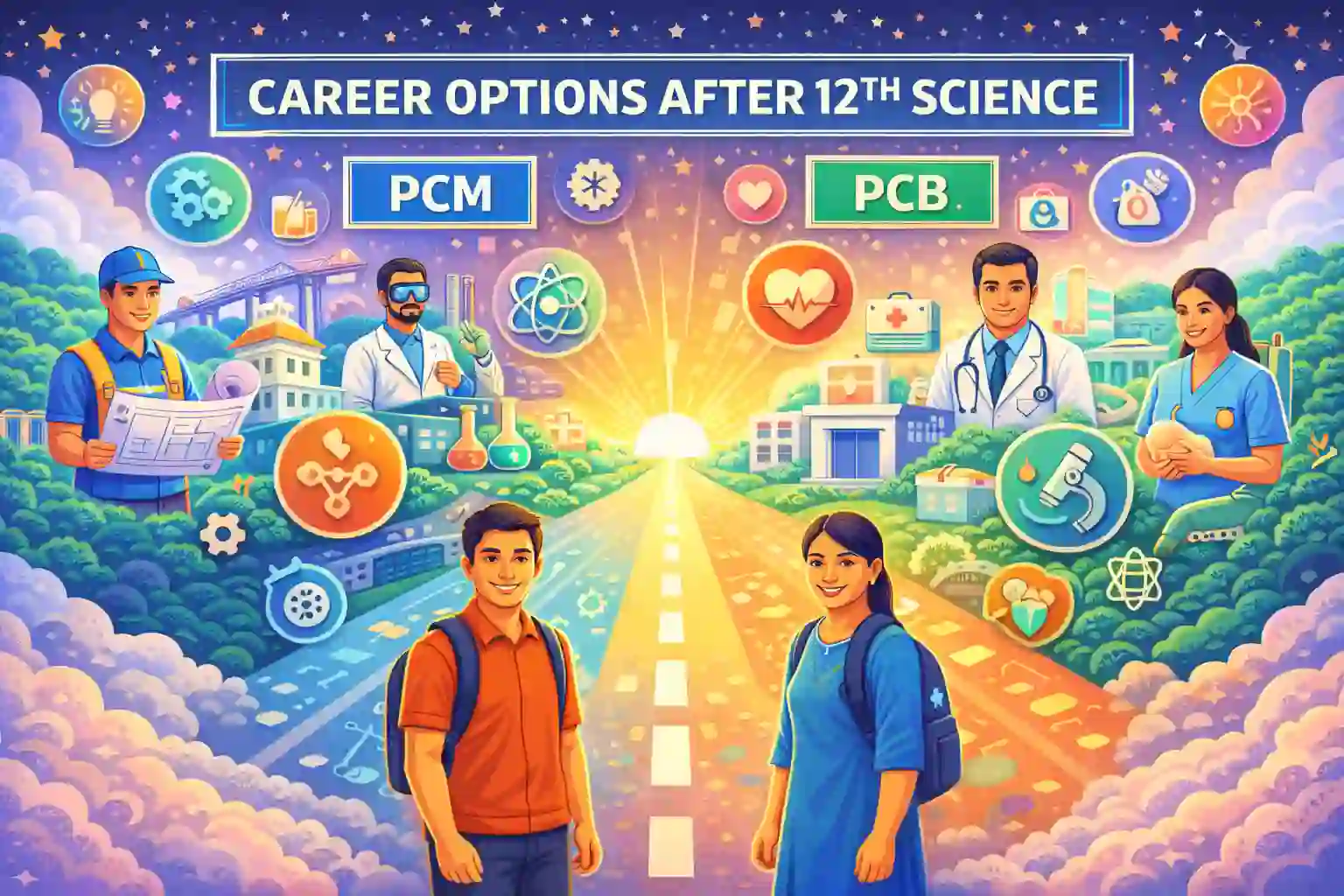
Ask most families this — what comes after 12th science? — and you will hear two words: engineering or medicine. Both are excellent careers — but they are just two of the many doors which the science stream actually opens. Science students go on to design buildings, fly aircraft, sail ships, analyse data, protect the country, run laboratories and build businesses. This article maps the career options after 12th science field by field: which ones your subjects open, how you get in, which you can start sooner, and — most importantly — how to work out which of them is the best fit for you rather than for the people around you.
In short: After 12th science you can move into engineering and technology, medicine and allied healthcare, research and the pure sciences, data science and AI, architecture and design, defence, aviation and the merchant navy, or switch to law and management. PCM opens technical and Maths-based fields, PCB opens healthcare and life sciences, and PCMB opens both. The right choice depends on your strengths and your interests, not just your marks.
First, Know Which Doors Your Streams/Subjects Open For You
Your Class 12 subjects decide which entrance exams you can sit, so it is the most practical place to start.
| Your subjects | Career fields that open up | Key routes to get in |
| PCM (Physics, Chemistry, Maths) | Engineering, computer science and AI, architecture, data science, pure sciences, NDA (all three wings), merchant navy, commercial pilot | JEE Main, JEE Advanced, NATA, CUET-UG, NDA (UPSC), IMU-CET |
| PCB (Physics, Chemistry, Biology) | Medicine, dentistry, AYUSH, pharmacy, nursing, physiotherapy, allied health, biotechnology, life sciences, agriculture | NEET-UG, CUET-UG, state and university tests |
| PCMB | Everything above, plus fields that combine both, such as bioinformatics and biomedical engineering | JEE, NEET and CUET, as relevant |
| Any stream (open to science students too) | Law, CA and commerce, management, design, hotel management, journalism, the civil services | CLAT, CA Foundation, CUET-UG, UCEED and NIFT tests, NCHM JEE, UPSC after graduation |
For the full course-by-course picture, see our articles on courses after 12th science PCM and on courses for PCB students, and if you studied all four subjects, our article on PCMB career options.
The Career Fields Science Leads To
Science after 12th leads to nine broad career fields, from engineering and medicine to defence, aviation, the pure sciences and management. Here is what each one involves and how you get in.
Engineering and technology
Still the most popular path for PCM students, and for good reason — an engineering degree opens core industry, IT, research, the public sector and, later, management. Admission to the IITs is through JEE Advanced, and to the NITs and many other institutes through JEE Main, with BITSAT for BITS Pilani, university tests such as VITEEE and SRMJEEE for private universities, and state entrance tests for state colleges. The branch matters as much as the college, so choose it by what you genuinely enjoy building or solving, not only by this year's placement figures. If coding and software interest you most, our article on computer science after 12th covers B.Tech CSE, BCA and B.Sc routes side by side.
Medicine and healthcare
MBBS, BDS and the AYUSH degrees (BAMS, BHMS, BUMS and others) all admit through NEET-UG, conducted by NTA. Medicine is a long, demanding commitment — MBBS alone takes five and a half years including the internship — and it suits students who have both the stamina and a genuine wish to care for people. Healthcare is also much wider than becoming a doctor: pharmacy, nursing, physiotherapy, radiology, medical laboratory technology and other allied-health careers offer secure and respected work, and many of them do not need NEET at all.
Research and the pure sciences
If what excites you is understanding why things work, a science degree leading to research may suit you better than a professional course. A B.Sc. or B.S. followed by an M.Sc. and a PhD leads to scientist and academic careers in universities, research-driven companies and national organisations such as ISRO, DRDO and the CSIR laboratories. There are dedicated routes too: the five-year BS-MS at the IISERs through the IISER Aptitude Test, and the five-year integrated M.Sc. at NISER and UM-DAE CEBS through NEST. Students in the top 1% of their Class 12 board who choose the natural sciences can also apply for the INSPIRE scholarship from the Department of Science and Technology.
Data, AI and computing
Some of the fastest-growing work today sits where Maths meets computers — data science, machine learning, cybersecurity and cloud computing. You can get there through a B.Tech, a BCA, or a B.Sc. in Computer Science, Data Science or AI, and what employers value most is what you can actually do: projects, internships and continuous learning.
Architecture and design
Architecture is a five-year B.Arch degree for students who enjoy both technical thinking and creative work. The Council of Architecture requires Physics and Mathematics in Class 12, and NATA (or JEE Main Paper 2 for some institutes) is the entrance test. Design — product, communication, interaction and UI/UX design — admits through tests such as UCEED, which several IITs accept from students of any stream.
Defence
The National Defence Academy, through the UPSC NDA examination, trains officers for the Army, Navy and Air Force. The Air Force and Navy wings require Physics, Chemistry and Mathematics in Class 12, so PCM students can apply for all three wings. Selection also involves an SSB interview and medical standards, so start preparing early if this is your goal.
Aviation and the merchant navy
Both suit PCM students who want a career beyond a desk. Becoming a commercial pilot means training for a licence regulated by the DGCA, which needs Physics and Mathematics in Class 12 and is a cost-intensive route. The merchant navy admits to courses such as the one-year Diploma in Nautical Science and the three-year B.Sc. Nautical Science through IMU-CET, with a PCM average of at least 60% and medical fitness required.
Life sciences, environment and agriculture
For PCB students who love the lab or the field rather than the clinic, biotechnology, microbiology, genetics, food technology, forensic science, environmental science and agriculture offer strong paths into research, industry and public service. Our article on biotechnology courses after 12th goes into one of the most popular of these in detail.
Beyond science altogether
Choosing science in Class 11 does not lock you in. Science students regularly move into law through CLAT, chartered accountancy, management, design, psychology, hotel management and journalism, and the civil services are open to graduates of any stream. If you feel your interests lie elsewhere, our article on the best courses other than engineering lays these routes out clearly.
Entrance Exams After 12th Science at a Glance
Most career options after 12th science begin with one entrance exam, so it helps to know which test leads where. The main national exams are below; state and university tests add many more seats.
| Exam | Conducted by | Leads to | Class 12 subjects |
| JEE Main | NTA | B.Tech/B.E. at NITs, IIITs and many other institutes; B.Arch and B.Planning through Paper 2 | PCM |
| JEE Advanced | One of the IITs, by rotation | B.Tech and dual degrees at the IITs | PCM, after qualifying JEE Main |
| NEET-UG | NTA | MBBS, BDS and the AYUSH degrees | PCB |
| CUET-UG | NTA | B.Sc. and other degrees at central universities and many others | Depends on the course |
| NDA | UPSC | Officer training for the Army, Navy and Air Force | Any stream for the Army; PCM for the Navy and Air Force |
| NATA | Council of Architecture | B.Arch | Physics and Mathematics |
| IISER Aptitude Test | The IISERs | Five-year BS-MS research programmes | Three of Physics, Chemistry, Mathematics and Biology, with 60% |
| NEST | NISER | Five-year integrated M.Sc. at NISER and UM-DAE CEBS | Science stream |
| IMU-CET | Indian Maritime University | Merchant navy courses | PCM, with an average of at least 60% |
| UCEED | IIT Bombay | B.Des at participating IITs | Any stream |
If you are unsure which of these to register for, first pick the two or three fields from the sections above that genuinely interest you — the exams follow from that choice, not the other way round. Registration for most of them closes months before the exam, so mark the dates on each official website early in Class 12. Our article on JEE career options explains what each engineering branch leads to.
Emerging Science Careers Worth Knowing
Alongside the established fields, a few newer career options after 12th science are growing quickly. They are worth a look if you like working on problems that will matter for the next few decades — though, honestly, "emerging" also means the job market is still taking shape, so build strong fundamentals rather than chasing a label.
- Renewable energy and climate technology — solar, wind and battery systems, reached mainly through electrical, mechanical or energy engineering.
- Biomedical engineering — medical devices and diagnostics, a natural fit for PCMB students who enjoy both biology and engineering.
- Robotics and automation — through mechanical, electronics or mechatronics engineering, with a lot of coding along the way.
- Space and satellite technology — engineering and physics routes into a sector that India is opening up to the private sector as well.
- Environmental science — pollution control, water and sustainability work in government, consulting and industry.
Careers You Can Begin Sooner
Not everyone wants — or can afford — a four- or five-year degree before earning. If you need to start working sooner, some science routes lead to work within one to three years:
- Allied-health and paramedical diplomas — such as medical laboratory technology or radiography, usually two to three years.
- Diploma in Pharmacy (D.Pharm) — two years of study plus practical training, open to PCB and PCM students, leading to registration as a pharmacist.
- The merchant navy — the one-year Diploma in Nautical Science, followed by training at sea.
- Skill-based IT roles — testing, support and junior development roles that some employers fill on the strength of proven skills; our article on IT jobs after 12th explains how.
Sometimes a shorter route is the smart choice — but honestly, not always. It depends on your strengths, your family's circumstances and how far you want to grow later, so weigh it carefully. Our article on job options after 12th compares these routes in more detail.
How to Choose the Right Path for You
With this many options, the biggest risk is not choosing a "bad" career — it is choosing one that is a mismatch for your talents because a friend, a relative or a trending headline pointed you there. Three honest questions help:
- What do you genuinely enjoy? Not what sounds impressive, but the subjects and activities you would happily spend hours on.
- What are you naturally good at? Analytical problem-solving, working with people, visual and creative thinking, careful lab work — each points to different fields.
- What kind of working life do you want? A long study path for a specialised profession, a faster start, work outdoors or at sea, research, or building something of your own.
In a GCL counselling session with a science student, the conversation rarely starts with marks. It starts with the student’s strengths, abilities and aptitude — the problems they enjoy solving, the subjects they love to study — because those interests and habits point to a field far more reliably than a rank list or a score card does.
These questions are harder to answer honestly than they look, which is where a scientifically proven career assessment helps. It measures your interests, strengths, abilities and personality and shows which of the science careers above are the best alignment for you — and sometimes reveals a stronger option which you had not even considered.
At Global Career Labs, a senior career counsellor then goes through your personalised career report with you and your parents, and turns it into a career plan: the best-fit course and college, a future-ready education plan, and a career path you can act on and follow to achieve your goals. It saves you time, money and a great deal of undue stress, and enables the right decision-making that shapes your next decade. If you would like to talk it through first, Contact GCL's Career Advisor.
Frequently Asked Questions
Which job is best in science stream?
There is no single best job — the science stream opens medicine, engineering, architecture, data science, research, pharmacy, nursing, IT and more. The best one for you depends on whether you prefer PCM-based technical and analytical fields or PCB-based healthcare and life sciences, and on your own strengths rather than which career sounds most impressive.
Which job is best without NEET?
Plenty of strong careers need no NEET — engineering and computer science (PCM), architecture, data science, pharmacy, biotechnology, physiotherapy, the allied-health and paramedical routes, forensic science and more. NEET is required only for MBBS, BDS and AYUSH, so science students have wide options beyond it.
Which course after 12th has the highest salary?
Courses often linked to higher earning potential include computer science and IT, data science and AI, specialised engineering, medicine and, in commerce, professional qualifications like CA. Pay depends far more on skill, role and experience than on the course label alone, so treat any "highest salary" claim as indicative and choose a course that also fits you.
Can I join AI after 12th?
Yes. After Class 12 (usually with Maths) you can enter AI through a B.Tech in Artificial Intelligence or Computer Science, a BCA or B.Sc in AI or Data Science, or foundational online courses in Python, machine learning and statistics. Starting early with practical projects alongside a degree is the most effective path.
What are 5 future jobs?
Frequently cited future-facing roles include AI or machine-learning engineer, data scientist, cybersecurity specialist, cloud computing professional and robotics or automation engineer. Healthcare, renewable energy and design roles are also growing. Most are reachable from the science stream, and all reward continuous, hands-on skill-building.
Can I get 100% job after B.Sc.?
No degree guarantees a job on its own — a B.Sc gives a solid foundation, but employability depends on your specialisation, practical skills and experience. B.Sc graduates improve their prospects strongly by adding a Master's, a professional certification or hands-on projects, and by choosing an in-demand field. Treat "guaranteed placement" claims with caution.
A Wide Stream Deserves a Careful Choice
The science stream gives you more options than almost any other — which is exactly why the choice deserves time and evidence rather than guesswork or pressure. Use the map above to see where your subjects can take you, shortlist two or three fields that genuinely excite you, and then test that shortlist against what you know about yourself. If you would like a senior career counsellor from Global Career Labs to help you do that with a scientifically proven assessment, explore our career guidance programs.
Related Readings
- Engineering vs Medical After 12th: Which Fits You?
- Medical Courses After 12th Without NEET
- NDA Exam and Defence Careers After 12th
- Career Guidance After 12th
- Courses After 12th: Options Across Every Stream