NDA Exam & Defence Careers After 12th: Eligibility, Selection & Career Path
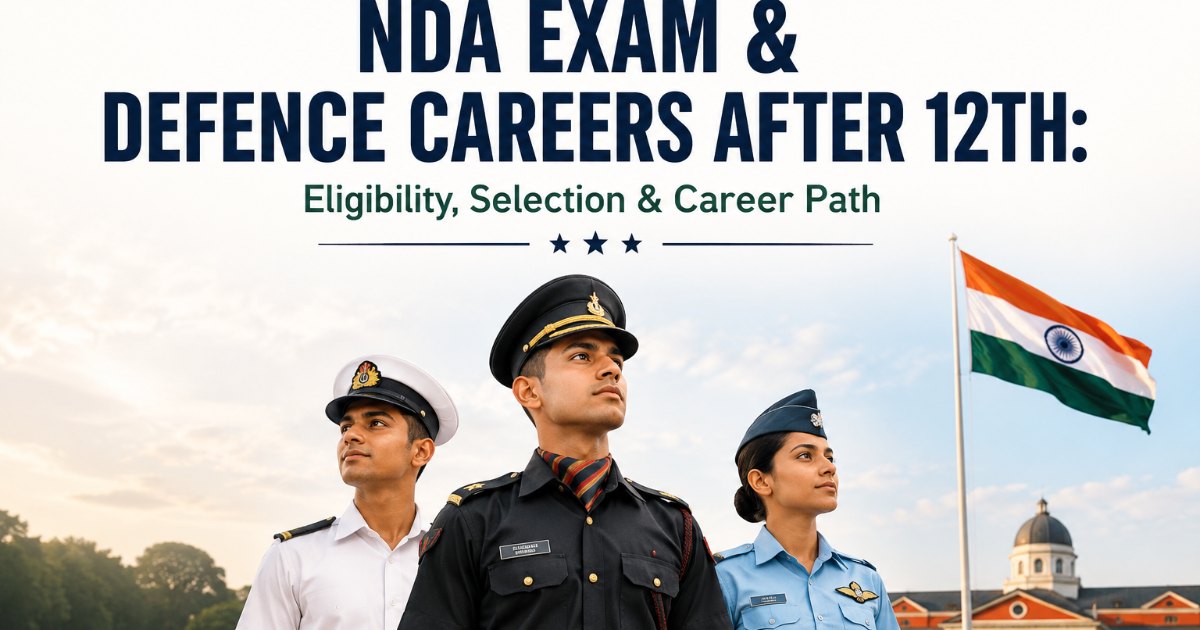
Considering nda exam? Quick answer: The NDA exam is a national entrance test conducted by UPSC twice a year for unmarried candidates aged 16.5 to 19.5 who have passed, or are appearing for, Class 12. Clearing the written papers and the SSB interview opens a fully funded route to becoming an officer in the Indian Army, Navy or Air Force straight after school.
The NDA exam is a national entrance test conducted by UPSC twice a year for unmarried candidates aged 16.5 to 19.5 who have passed, or are appearing for, Class 12. Clearing the written papers and the SSB interview opens a fully funded route to becoming an officer in the Indian Army, Navy or Air Force straight after school.
For a student finishing Class 12, most careers start with three or four more years of college and then a job hunt. The armed forces offer a different shape of career: you enter officer training directly after school, earn a recognised bachelor's degree while you train, and step into a leadership role with a fixed pay structure. The National Defence Academy (NDA) route is the main door into this world after 12th, and this guide walks through exactly how it works — eligibility, the exam, the interview, training and the officer path — so you can judge honestly whether it fits you.
What is the NDA and who runs the exam?
The National Defence Academy is the tri-services academy at Khadakwasla, near Pune, where future officers of the Army, Navy and Air Force train together before moving on to their service-specific academies. The NDA & NA Examination is the entrance test for this pathway.
Two bodies share the selection:
- UPSC (Union Public Service Commission) conducts the written examination and publishes the notification, application process and results.
- The Services Selection Board (SSB), run by the armed forces, conducts the interview and personality assessment for candidates who clear the written test.
The exam is held twice a year — NDA 1 (usually written around April) and NDA 2 (usually around September). For the 2026 cycle, the NDA 1 written exam was held on 12 April 2026 and NDA 2 is scheduled for 13 September 2026, with roughly 394 vacancies notified each cycle. Vacancy counts and dates change with every notification, so always confirm the live figures on the official UPSC website before you plan.
Is a defence career after 12th right for you?
Before the eligibility checklist, it helps to be clear-eyed about what you are choosing. A commission through the NDA is not simply a “government job” — it is a demanding, physically active service career with postings anywhere in the country, real responsibility from a young age, and a fixed, transparent pay and pension structure. If you value structure, teamwork, the outdoors and leading people, it can be deeply rewarding. If you are drawn mainly by pay figures or job security, it is worth comparing calmly against other jobs after 12th and the wider set of career options after 12th before committing years of preparation.
NDA eligibility 2026: age, stream and other conditions
The eligibility rules are set by UPSC and are broadly the same for the 2026 cycle. The core requirements are:
- Nationality: Indian citizen (with the usual provisions for subjects of Nepal/Bhutan and certain migrants, as detailed in the notification).
- Age: between 16.5 and 19.5 years as on the date specified in the notification. There is no age relaxation — the birth-date window is strict.
- Marital status: candidates must be unmarried and must remain unmarried until training is completed.
- Education: passed Class 12 (10+2) from a recognised board, or appearing in Class 12. Candidates in Class 12 can apply provisionally.
The important detail most people miss is that the stream requirement depends on which service you want:
- Army wing: Class 12 pass in any stream is accepted — arts, commerce or science.
- Air Force, Navy and the Naval Academy course: you must have studied Physics and Mathematics at 10+2. So a non-science student can join the Army wing but not the flying or naval branches through NDA.
This is why students aiming at the Air Force or Navy through the NDA are usually the ones choosing the science stream after 12th with Physics and Maths. If you are still in Class 11, your subject choice quietly decides which doors stay open.
Can girls apply? Yes. Following the Supreme Court's 2021 ruling, women became eligible for the NDA, and the first women candidates were inducted from the NDA 2 2022 cycle onwards. Women and men sit the same exam, the same SSB and, once commissioned, follow the same pay structure — subject to the branch-wise vacancies published in each notification.
The three services you can join through the NDA
The NDA feeds all three armed forces. Where you end up depends on the wing you qualify for and your merit position, and after the common NDA phase each service sends you to its own academy. Here is how the three compare at a glance.
| Service (wing) | 12th stream needed | Service academy after NDA | Broad role |
|---|---|---|---|
| Indian Army | Any stream | Indian Military Academy (IMA), Dehradun | Land forces — combat, engineering, signals, logistics and more |
| Indian Navy | Physics & Maths | Indian Naval Academy (INA), Ezhimala | Ships, submarines and maritime operations |
| Indian Air Force | Physics & Maths | Air Force Academy (AFA), Hyderabad | Flying and technical/ground-duty branches |
| Naval Academy course | Physics & Maths | Indian Naval Academy (INA), Ezhimala | Executive/technical branches of the Navy |
You indicate your service and wing preferences in the application, but the final allotment depends on your merit and the vacancies available in each branch that cycle.
The NDA selection process, step by step
The NDA selection process has two scoring stages of equal weight, plus a qualifying medical:
- Written examination (900 marks) — conducted by UPSC in offline pen-and-paper mode.
- SSB interview (900 marks) — a roughly five-day personality and intelligence assessment for those who clear the written stage.
- Medical examination — a qualifying check of medical and physical standards.
The final merit list is prepared out of 1,800 marks (900 written + 900 SSB). Note the balance: the interview carries exactly as much weight as the written exam, so strong academics alone will not carry you through — officer-like qualities matter just as much.
NDA written exam pattern
The written test has two papers, both taken on the same day:
- Paper 1 — Mathematics: 300 marks, 120 questions. Each correct answer earns 2.5 marks; each wrong answer deducts about 0.83 marks. Duration 2 hours 30 minutes.
- Paper 2 — General Ability Test (GAT): 600 marks, 150 questions covering English and General Knowledge (Physics, Chemistry, General Science, History, Geography and Current Affairs). Each correct answer earns 4 marks; each wrong answer deducts about 1.33 marks. Duration 2 hours 30 minutes.
Both papers are objective (multiple choice), and the negative marking means blind guessing hurts your score. The GAT's 600 marks make general knowledge and English the larger battlefield, but Mathematics is where many candidates gain or lose their edge. Exact marks, question counts and the syllabus are laid out in the UPSC notification and the National Defence Academy site — check the current NDA and UPSC documents for the version that applies to your cycle.
The SSB interview: five days that decide as much as the exam
The SSB is where the forces assess whether you have the temperament to lead. It runs over about five days at a Selection Board and is split into two stages:
- Stage I (screening, Day 1): an Officer Intelligence Rating test plus Picture Perception and Discussion. Only candidates who clear this stage continue — a large share is screened out here.
- Stage II (Days 2–5): psychological tests, Group Testing Officer (GTO) tasks — group discussions, outdoor group tasks, the command task — and a personal interview, followed by a conference.
Recommended candidates then undergo a medical examination. The SSB is not something you can cram for in a week; it rewards genuine communication, decision-making, physical fitness and honesty. This human element is a large part of why the NDA differs from a purely written recruitment test.
Training: what happens after you clear the NDA
Selection is the beginning, not the end. The training path is structured and, importantly, largely funded by the government:
- Three years at the NDA, Khadakwasla, combining academics, military training and physical conditioning. Cadets are awarded a bachelor's degree (in science, arts or computer science) affiliated to Jawaharlal Nehru University — so you graduate with a recognised degree alongside your officer training.
- About one year at the service academy — IMA Dehradun (Army), INA Ezhimala (Navy) or AFA Hyderabad (Air Force) — for service-specific training.
- Commissioning as an officer (Lieutenant in the Army, or the equivalent rank in the Navy and Air Force).
During the final year of pre-commission training, cadets receive a fixed stipend — indicatively around ₹56,100 per month (7th Pay Commission level; treat this as indicative and verify with the official source, as it is revised over time). The broader point is that you are not paying college fees during these years — the training is state-funded.
Officer career path and pay (indicative)
On commissioning, an officer enters at Level 10 of the pay matrix. As an indicative reference under the 7th Pay Commission, the starting basic pay is around ₹56,100 per month, plus a Military Service Pay of roughly ₹15,500 per month, along with Dearness Allowance and service-specific allowances (such as flying, submarine or high-altitude allowances where applicable). These figures are indicative and vary — the exact, current numbers are set by government pay rules, so verify them against the official service pages before relying on them.
Beyond pay, the officer path offers a defined promotion ladder (Lieutenant to Captain, Major and upward, with equivalents in the Navy and Air Force), pension and medical benefits, subsidised accommodation, and leadership responsibility that grows early. It is a long-term commitment rather than a job you switch out of casually — which is exactly why the honest self-assessment at the start matters. For a wider comparison with civilian public-sector options, our guides to central government jobs put the defence route in context.
How to join the Indian Army after 12 without the NDA
The NDA is the main officer route straight after 12th, but it is not the only way into uniform. If you miss the age window, do not clear the exam, or want a different entry, consider:
- Agnipath / Agniveer entry — recruitment into the Army, Navy and Air Force as soldiers/sailors/airmen (not officers) after Class 10 or 12, depending on the trade.
- Technical and other entries later — officer schemes such as the Technical Entry Scheme and, after graduation, the CDS examination, which open further officer routes for those who pursue a degree first.
- Other uniformed services — paramilitary and police forces recruit at various levels; you can explore these alongside the armed forces in our overview of government jobs in India.
In short, a career in the forces is not a single, one-shot exam — it is a set of doors that open at different ages and qualification levels.
How to start preparing right now
If the NDA looks like your path, a few practical steps help more than any shortcut:
- Fix your subjects early. If you are still in Class 11 and might want the Air Force or Navy, keep Physics and Mathematics.
- Track your age window. The 16.5–19.5 band is narrow — map which cycles you are eligible for before you plan.
- Build the written base: strong Class 11–12 Maths, English and broad general knowledge/current affairs for the GAT.
- Work on the SSB qualities from now: communication, physical fitness, teamwork and clear decision-making — these cannot be built overnight.
- Read the official notification yourself each cycle rather than relying on summaries.
A defence career after 12th is one of the few routes that combines a recognised degree, funded training and an officer's role from a young age. It asks a lot in return — discipline, fitness and a genuine willingness to serve. If that matches who you are, the NDA is a serious, honourable path worth preparing for properly. If you are still weighing it against other directions, a structured conversation can help you decide with a clear head rather than under exam-season pressure.
GCL supports 125,000+ students & professionals across 140+ cities through a network of 3,200+ career counsellors — if you want help mapping the defence route against your strengths and your other options, that guidance is available.
Modern Curriculum & Future-Ready Colleges for Nda exam
What nda exam now teach: Explained the modern NDA training model — 3 years at Khadakwasla combining academics with military/physical training and a JNU-affiliated bachelor's degree (science/arts/computer science), followed by ~1 year of service-specific training at IMA/INA/AFA before commissioning. This shows candidates they earn a recognised degree alongside officer training, not just drill..
Colleges using advanced learning: Named the actual training institutions on the pathway — National Defence Academy, Khadakwasla (Pune); Indian Military Academy, Dehradun; Indian Naval Academy, Ezhimala; Air Force Academy, Hyderabad — plus the degree-awarding affiliation (JNU), so readers know exactly which institutions the NDA route leads to.. When you compare nda exam, prioritise colleges following this updated curriculum.
NDA Exam & Defence Careers After 12th: Frequently Asked Questions
What is an NDA salary?
Cadets are paid a stipend during training, as set out in the UPSC notification, rather than a full salary. After commissioning as officers (Lieutenant or equivalent), they are paid on the Central Pay Commission scale for their rank, plus military service pay and allowances. Check the official defence recruitment websites for current figures.
Can a 20-year-old apply for NDA?
Usually not — the NDA age window is roughly 16.5 to 19.5 years on the notified cut-off date, so most 20-year-olds are over the limit. Older candidates can still become officers through other entries such as CDS after graduation, so a defence career stays open.
Is 75% necessary for NDA?
No — the NDA has no minimum percentage. You need to have passed, or be appearing in, Class 12 — any stream for the Army wing, and science with Maths for the Air Force and Navy wings. Selection depends on the UPSC written exam and the SSB interview, not your board percentage.
Which is tougher, NDA or CDS?
Both are demanding in different ways. The NDA comes right after Class 12, with a heavy maths paper plus a general ability test; CDS is for graduates and tests English, general knowledge and elementary maths. Many find the NDA maths tougher, while CDS has intense competition for fewer seats. For both, the SSB interview is the real decider.
How can girls apply for the NDA?
Girls apply through the same UPSC NDA exam as boys, online on the UPSC website, twice a year. Candidates must be unmarried, within the notified age window (roughly 16.5 to 19.5), and have passed or be appearing in Class 12 — any stream for the Army wing, and science with Maths for the Air Force and Navy. Selection is the written exam, then the SSB interview and a medical check.
Is the NDA easy or tough?
It is considered tough. Candidates must clear the UPSC written exam in Mathematics and the General Ability Test, then the SSB interview, which assesses personality and officer-like qualities, and a medical examination. Only a small share of applicants reach the final merit list, so steady preparation for every stage matters.
Related Guides
- Government Jobs In India
- Career Options After 12th Science
- Best Jobs After 12th
- Career Options After 12th
- Central Government Jobs
Official Sources & Further Reading
Key takeaway: the best nda exam match your interests, budget and goals — a quick aptitude check helps you decide with confidence.
Disclaimer:
Salary figures, course fees and other course details & career information provided in this article are for general reference only and may vary based on location, company, experience & market conditions. All kinds of information and data shared in this article have been sourced from publicly available websites and digital platforms. Readers are advised to independently verify all information from official and authentic sources before making any career decisions and educational decisions. GlobalCareerLabs.com does not guarantee the accuracy or authenticity of this data. And so, Global Career Labs shall not be held responsible for any decisions made on the basis of this information.