Nursing Course After 12th: B.Sc Nursing, ANM, Eligibility and Careers
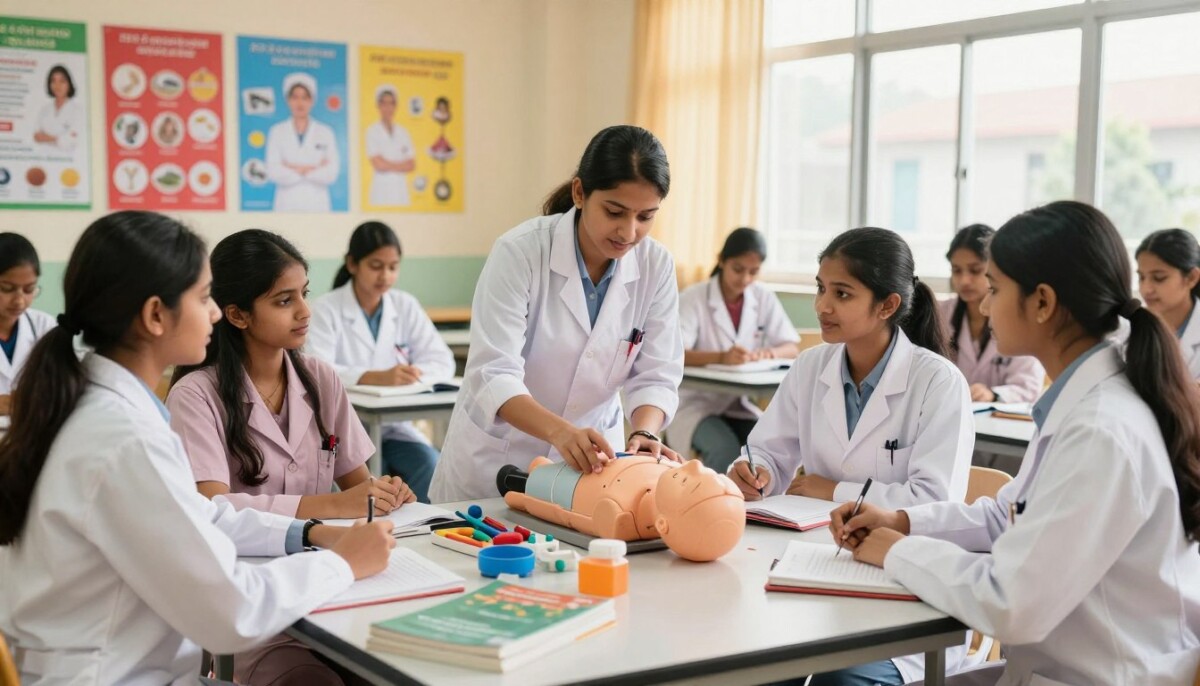
Nursing is one of the most respected and secure careers in healthcare — and one of the few where you can make a real difference to people's lives from your very first day at work. If you are considering a nursing course after 12th, the choices can still feel confusing: B.Sc Nursing, GNM, ANM, Post Basic, NEET or no NEET. This article explains each nursing course, who is eligible, how admission works, what happens to PCM and arts students, what the course and registration involve, and the career paths which open up afterwards.
In short: The main nursing course after 12th is the four-year B.Sc Nursing, which needs Physics, Chemistry, Biology and English in Class 12 with at least 45% in PCB. ANM is a two-year course open after Class 12, while GNM is being phased out in favour of B.Sc Nursing. Choose an Indian Nursing Council-recognised college, because registration as a nurse depends on it.
Nursing Courses After 12th at a Glance
The Indian Nursing Council (INC) sets the standards for nursing education in India. The table below compares the main nursing courses which you can join after Class 12.
| Course | Duration | Who can join | Where it leads |
| B.Sc Nursing | 4 years | Class 12 with PCB and English; at least 45% in PCB taken together; minimum age 17 | Registered nurse, hospital and community roles, teaching, M.Sc Nursing |
| ANM (Auxiliary Nurse Midwife) | 2 years | Class 12 pass | Community health and primary health centre roles; further nursing study |
| GNM (General Nursing and Midwifery) | 3 years | Varies by state and institute while it is being phased out | Hospital nursing; Post Basic B.Sc Nursing later |
| Post Basic B.Sc Nursing | 2 years | GNM holders registered as nurse and midwife | A nursing degree for those who started with GNM |
The Indian Nursing Council has decided to phase out GNM in favour of the four-year B.Sc Nursing, although some states and institutes still run it during the transition. If you are choosing today, B.Sc Nursing is the safest long-term route; check the current INC and state notices before you apply for GNM.
B.Sc Nursing: Eligibility, Admission and What You Study
B.Sc Nursing is the course which most students opt for when they think of a nursing career. Its eligibility is set by the Indian Nursing Council, and admission is run by states, universities and individual institutes.
- Subjects: Class 12 (10+2) with Physics, Chemistry and Biology, and English as a compulsory subject.
- Marks: at least 45% in these three science subjects taken together, with pass marks in English; relaxations for reserved categories follow the rules in force.
- Age: at least 17 years on 31 December of the year of admission.
- Other conditions: you must be medically fit, and married candidates are also eligible.
Admission routes differ. Many colleges admit students on Class 12 marks or through a state or university nursing entrance test, while some institutes and states use NEET-UG scores. The Military Nursing Service, for example, uses NEET-UG scores to shortlist women candidates for its four-year B.Sc Nursing course at Armed Forces hospitals. Always check the admission notice of each college on your list.
During the course you will study anatomy, physiology, nutrition, pharmacology, nursing foundations, medical-surgical nursing, child health, mental health, community health and midwifery, with long clinical postings in hospitals and communities. It is demanding, practical and deeply human work.
B.Sc Nursing Year by Year
The B.Sc Nursing course runs for four years, and each year builds on the last. The exact order of subjects varies between universities, but a typical structure looks like this:
| Year | Typical focus |
| Year 1 | Anatomy, physiology, nutrition, biochemistry, communicative English and the foundations of nursing |
| Year 2 | Pharmacology, pathology, adult health (medical-surgical) nursing and community health nursing |
| Year 3 | Child health nursing, mental health nursing and advanced adult health nursing |
| Year 4 | Midwifery and obstetric nursing, community health, nursing research and management, with an extended clinical internship |
Clinical work grows every year, so by the final year you spend much of your time on hospital and community postings under supervision.
Nursing After 12th: A Step-by-Step Plan
A clear plan, started early, makes nursing admission far less stressful. Here is the usual sequence.
- Class 11: choose the PCB stream with English, because B.Sc Nursing needs Biology.
- Class 12: aim comfortably above 45% in PCB taken together, since competitive colleges admit well above the minimum.
- Shortlist colleges: list INC-recognised government and private colleges in your state and beyond, with their admission routes.
- Entrance tests: note whether each college uses Class 12 marks, a state or university nursing entrance test or NEET-UG, and sit for the ones you need.
- Documents: keep your mark sheets, age proof, category and domicile certificates and a medical fitness certificate ready.
- Counselling and admission: follow each state's or institute's counselling schedule closely, because seats are allotted round by round.
Nursing Entrance Exams After 12th
There is no single national entrance exam for all nursing courses after 12th. The exam you need depends on the college and the state.
- NEET-UG: conducted by the National Testing Agency, and used by some institutes and states for B.Sc Nursing, as well as by the Military Nursing Service.
- State nursing entrance tests: several states run their own tests or counselling for nursing seats in government and private colleges.
- University and institute tests: some universities and private institutes hold their own nursing entrance exams.
- Merit-based admission: many colleges still admit students on Class 12 marks, within the INC eligibility rules.
Most nursing entrance tests cover Physics, Chemistry and Biology from Classes 11 and 12, often with English and general aptitude. If you prepare for NEET-UG, you will usually be well prepared for state and institute nursing tests too.
Government Nursing Colleges and Seats
Government nursing colleges are usually the first choice for students and families, because their fees are much lower and their attached hospitals give wide clinical exposure.
Government nursing college seats are offered by colleges attached to government medical colleges and hospitals, central institutions and state health departments. Admission is competitive, and it normally runs through state or institute counselling with reservation rules. Watch your state's health department and counselling notices from the time of your Class 12 board exams, so that you do not miss an application window. If you are aiming for a government college seat, it is sensible to apply to a few recognised private colleges as well, so that you have a back-up option.
Can PCM or Arts Students Do Nursing?
PCM students without Biology are not eligible for B.Sc Nursing, because the INC requires Biology along with Physics and Chemistry in Class 12. Arts and commerce students face the same rule for B.Sc Nursing, but they still have routes into nursing and healthcare.
- PCM students: some students add Biology later through an open-school board; check with your target colleges whether they accept it before you plan this route. Otherwise, allied health courses which accept PCM, such as some medical technology programmes, are worth comparing.
- Arts and commerce students: ANM is open after Class 12, and it gives a recognised start in community health work. Our article on medical courses after 12th without NEET lists other healthcare options.
- Still in Class 10 or 11? If nursing is your goal, choose Biology now. Our article on courses after 12th science PCB shows where the PCB stream can lead.
Is Nursing a Good Career for Boys?
Yes — nursing is a professional career for anyone with the right aptitude and temperament, and men work as nurses in hospitals, intensive care units, emergency departments and community health across India and abroad.
A few institutes and programmes admit only women — the Military Nursing Service is one example — so check each college's eligibility before you apply. Many government and private colleges admit male candidates to B.Sc Nursing, and male nurses are often in demand in critical care, emergency and psychiatric nursing.
One-Year Nursing Courses: What They Really Are
There is no one-year course after Class 12 which makes you a registered nurse in India. Short healthcare courses of a few months to a year exist, but they lead to support roles, not to nursing registration.
Courses such as general duty assistant, patient care assistant or home health aide, offered through skill-development schemes and private institutes, teach basic patient care and hospital routines. They can be a good way to start working in healthcare quickly or to test whether you enjoy patient care — but if you want to become a nurse, plan for B.Sc Nursing or ANM. Our article on paramedical courses after 12th covers other short and medium-length options.
If you are still deciding between nursing and other healthcare degrees, compare the work itself as well as the course. Nursing centres on continuous patient care, pharmacy on medicines, and physiotherapy on movement and rehabilitation. Our article comparing B.Sc Nursing, B.Pharm and BPT sets these three paths side by side.
How to Choose a Nursing College
Choose a nursing college for its recognition and clinical training first, and for its name and fees second.
- Check recognition: the college and the course should be recognised by the Indian Nursing Council and the State Nursing Council; without this, you may not be able to register as a nurse.
- Look at the attached hospital: the size of the parent or attached hospital decides how much real clinical experience you get.
- Ask about clinical postings: rotations through medicine, surgery, paediatrics, obstetrics, community health and mental health are a sign of a strong programme.
- Compare fees carefully: government colleges usually charge far less than private ones, and private B.Sc Nursing fees vary widely across states, so compare the total cost of all four years, including hostel.
- Read the admission notice: confirm the entrance route, the reservation rules and the last dates for each college.
After the Course: Registration and Career Paths
After passing a recognised nursing course, you register with your State Nursing Council as a nurse and midwife. Registration is what allows you to practise, and it is required for most government jobs and for working abroad.
- Hospitals: staff nurse roles in government and private hospitals, with growth into specialist units, ward management and nursing administration.
- Community health: primary health centres, public health programmes and home care.
- Armed forces: the Military Nursing Service also grants short service commissions to women who hold a recognised nursing degree and are registered nurses and midwives.
- Teaching and research: with an M.Sc Nursing, a two-year postgraduate degree, you can teach in nursing colleges and move into research.
- Working abroad: many countries recruit Indian nurses, after their own licensing exams and language tests.
- Healthcare management: with experience, many nurses move into hospital administration — see our article on the hospital management course after 12th.
Salaries vary by state, hospital, specialisation and experience, so treat any figure you see online as indicative rather than a promise.
Is Nursing the Right Fit for You?
Nursing suits people who combine scientific ability with patience, empathy and calm under pressure. It involves long shifts, night duty and emotionally demanding moments, as well as the deep satisfaction of caring for people when they need it most.
When a GCL counsellor discusses nursing with a student, the first thing they check is whether the student's interest in caring for people is matched by aptitude for science and by the temperament for hospital work. Students who choose nursing for the right reasons tend to stay and grow in it, while those who choose it only as a fallback after NEET often struggle.
At Global Career Labs, a scientifically proven assessment measures your interests, strengths, abilities and personality. A senior career counsellor from Global Career Labs then goes through your personalised career report with you and your parents, and turns it into a career plan: whether nursing fits you, which nursing or healthcare course to choose, and the career path which is the best alignment for your strengths and talents. See our career guidance programs, or Contact GCL's Career Advisor to discuss it first.
Nursing Course After 12th: Frequently Asked Questions
Which nursing course is best after 12th?
For a long-term career, B.Sc Nursing (four years) is the strongest option — a degree that opens hospital, teaching, abroad and higher-study paths. GNM (a three-year diploma) and ANM (two years) are shorter routes into practice. B.Sc Nursing needs Class 12 with PCB, while GNM is more flexible on stream.
Which is better, BSc or GNM?
B.Sc Nursing is a four-year degree with broader scope — better for senior roles, teaching, an M.Sc and working abroad — while GNM is a three-year diploma that gets you into practice faster and is open to more streams. If you can, B.Sc Nursing gives more long-term options; GNM is a practical, faster start.
Can I do BSc Nursing without NEET?
In most colleges, yes — admission runs on Class 12 (PCB) marks or a state or university nursing entrance. However, a growing number of institutes and some states now use NEET scores for B.Sc Nursing, so check the rules of each college you are targeting.
What is the 3-year nursing course?
It is GNM (General Nursing and Midwifery), a diploma that trains you for hospital nursing and midwifery. It is open after Class 12 — science is preferred, though many institutes accept other streams — and GNM holders can later upgrade through a Post-Basic B.Sc Nursing.
Is B.Sc Nursing tougher than MBBS?
No — MBBS is longer (5.5 years), far more competitive through NEET, and goes deeper into medicine. B.Sc Nursing is still demanding, with anatomy, physiology, pharmacology and long clinical hours, but it is more accessible. They are different careers, not easier or harder versions of each other.
Can a B.Sc nurse become a doctor?
Not directly — becoming a doctor needs an MBBS through NEET, which is a separate path. A nurse can grow into advanced roles such as specialist nurse, nurse practitioner or nursing educator through an M.Sc and specialised training. If becoming a doctor is the goal, NEET and MBBS is the route.
Choose Nursing With Care — and for the Right Reasons
A nursing course after 12th opens a secure, respected and meaningful career, at home and abroad. Choose a recognised B.Sc Nursing or ANM course, check every admission notice carefully, and make sure the work truly suits your strengths and temperament. If you would like a senior career counsellor from Global Career Labs to help you decide, with a scientifically proven assessment behind the decision, start with our career guidance programs.
Related Readings
- B.Sc Nursing vs B.Pharma vs BPT
- ANM Nursing Course
- Paramedical Courses After 12th
- Physiotherapy Course After 12th
- Medical Courses After 12th Without NEET