Courses After 12th Science PCB: The Complete Map for 2026
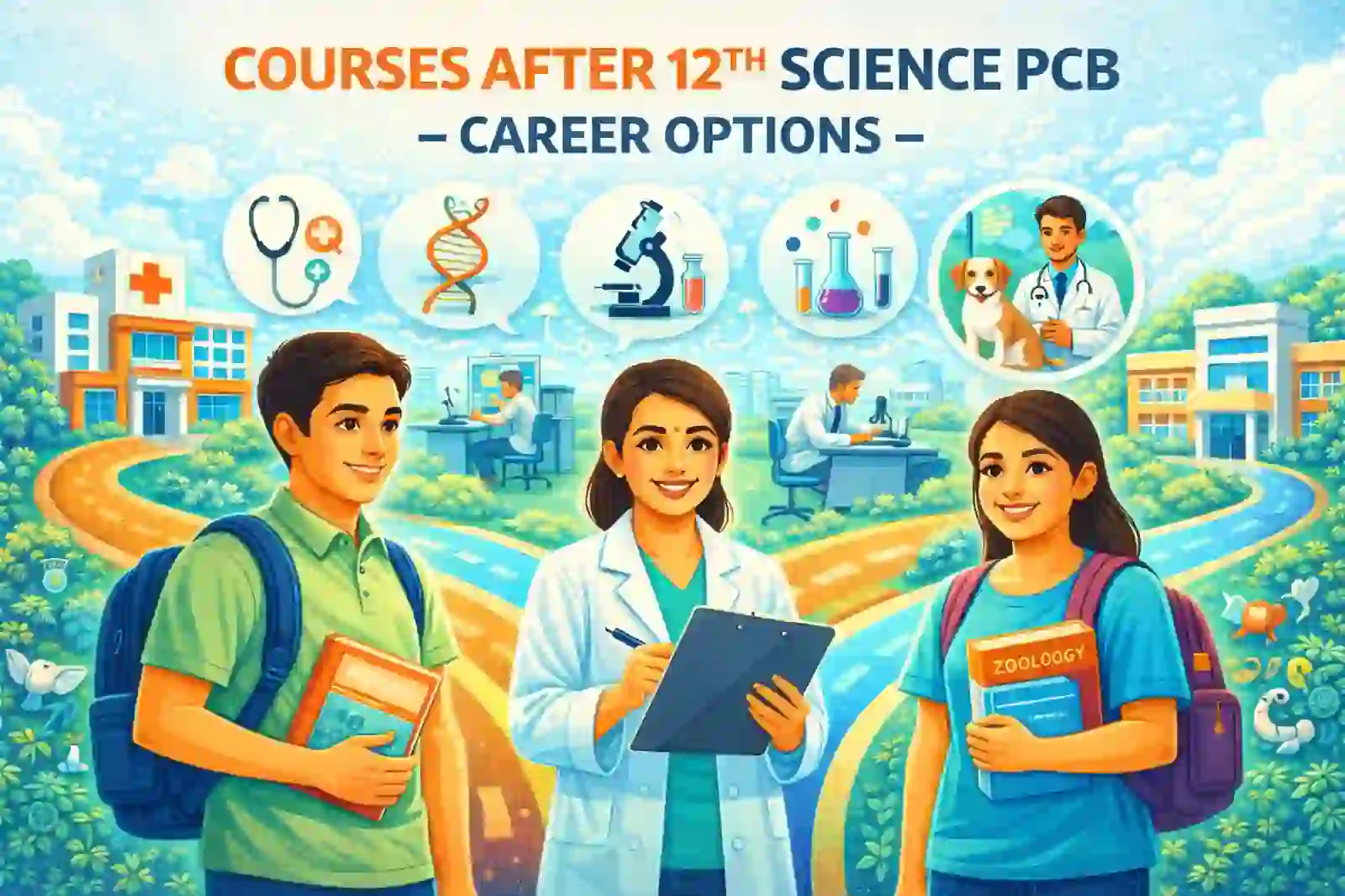
Finishing Class 12 with Physics, Chemistry and Biology puts you in one of the most respected — and most misunderstood — positions in Indian education. Misunderstood, because the moment you say "PCB", everyone assumes MBBS, and treats everything else as a backup. The truth is far wider: PCB opens medicine, yes, but also dentistry, nursing, pharmacy, therapy, the whole allied-health world, the life sciences and research, agriculture, and even routes outside biology altogether. This guide is the complete map of courses after 12th science PCB — every major route, whether it needs NEET or not, and how to choose the one that genuinely fits you rather than the one everyone expects.
In short: After 12th PCB you can pursue the NEET-gated medical routes (MBBS, BDS, and the AYUSH degrees like BAMS and BHMS) and a much wider set that mostly needs no NEET — pharmacy (B.Pharm), physiotherapy (BPT), the paramedical and allied-health courses, the life sciences (biotechnology, microbiology, genetics), agriculture, nutrition and forensic science — plus nursing (B.Sc Nursing), which increasingly requires NEET too. PCB is not a one-way road to MBBS; the right choice depends on whether you are drawn to clinical care, research, industry or an applied field.
The Two Big Buckets: NEET and Non-NEET
The single most useful way to see your options is to split them along one line: does the course need NEET? NEET is the gateway to becoming a doctor or dentist and to the AYUSH degrees — but it gates only a slice of what PCB opens. A very large, respected world of healthcare, science and applied careers sits entirely outside it.
Route family | Example courses | NEET needed? |
Medicine & dentistry | MBBS, BDS | Yes |
AYUSH | BAMS, BHMS, BUMS, BNYS | Yes |
Nursing | B.Sc Nursing, GNM | Increasingly yes |
Pharmacy | B.Pharm, D.Pharm | No |
Allied health & therapy | BPT, BMLT, radiology, optometry, OT technology | Mostly no |
Life sciences & research | B.Sc Biotechnology, Microbiology, Genetics, Zoology, Botany | No |
Applied & other | Agriculture, Nutrition & Dietetics, Forensic Science, Environmental Science | No |
The Medical Route — MBBS and Beyond
For the students set on becoming a doctor, the road is clear and demanding: NEET-UG, then MBBS (5.5 years including internship), and usually a postgraduate specialisation after that. Dentistry (BDS) and the AYUSH degrees — Ayurveda (BAMS), Homoeopathy (BHMS) and others — are the allied medical routes, also through NEET. These are long, respected commitments to clinical medicine, and they suit a student with genuine patience, resilience and a pull towards patient care. If you are weighing whether this is truly your path — rather than an expectation you have absorbed — it is worth choosing it deliberately, not by default.
The NEET and MBBS Journey, Step by Step
For the students who genuinely do want medicine, it helps to see the whole road in advance, because it is a long one. It runs roughly like this:
- NEET-UG — the single national entrance exam, taken in Class 12 or after, on the PCB syllabus; your rank decides your college and course, and serious preparation usually begins in Class 11.
- MBBS — four and a half years of study plus a one-year compulsory rotating internship, so about 5.5 years in all, to qualify as a registered doctor.
- Specialisation (MD/MS) — most doctors then sit NEET-PG for a three-year postgraduate specialisation, and some go further into the super-specialties (DM/MCh).
Dentistry (BDS) follows a similar NEET route over five years including internship, and the AYUSH degrees — BAMS in Ayurveda, BHMS in Homoeopathy, and the Unani and Naturopathy programmes — are five-and-a-half-year, NEET-gated courses for students drawn to India's traditional systems of medicine, each with its own growing scope. The honest thing to weigh is the length and the competition: NEET is fiercely contested, and the road to an independent medical career is close to a decade of committed study. That is worth entering with real conviction, not merely because it is expected — which is exactly why the choice deserves a clear-eyed look at whether clinical medicine truly fits you, before the years are committed.
The Wide World Beyond NEET
This is the part most PCB students under-explore, and it is where a great many of them are genuinely better suited. Rather than repeat the detail here, we cover these routes in their own dedicated guides — but in brief:
- Pharmacy, physiotherapy and allied health — the practical, employable backbone of healthcare, most of it needing no NEET. Our guide to medical courses after 12th without NEET maps these in full, and our comparison of BSc Nursing, B Pharma and BPT weighs three of the most popular.
- Life sciences and research — biotechnology, microbiology, genetics and the research path, for students who love the science itself. Our guide to bio courses after 12th goes deep on these.
- Nursing — one of the most in-demand careers at home and abroad, covered in our nursing course after 12th guide (note that NEET is now required at a growing number of nursing colleges).
- Applied fields — agriculture, nutrition and dietetics, forensic science and environmental science, each a distinctive and growing direction.
And the Routes Outside Biology Altogether
It is worth knowing, too, that PCB does not lock you inside science. A PCB student can move towards management (BBA), computer applications (BCA), law (the integrated five-year degrees via CLAT), design, hospitality or the humanities at the degree stage — plenty of students discover, after Class 12, that their real interest lies elsewhere, and none of those doors is closed. If that is you, it is far better to pivot deliberately now than to push through a science degree that does not fit.
How to Choose — From Expectation to Fit
The defining challenge for a PCB student is not a shortage of options — it is the weight of expectation, because "PCB means doctor" is one of the most fixed assumptions in Indian families. That pressure is exactly why so many capable biology students either force themselves through a medical path that does not suit them, or drift into a random alternative when NEET does not go their way. Neither is a real choice.
The better approach is to work from your own wiring: are you drawn to clinical care, to research and the lab, to industry and medicines, or to something applied? That is genuinely hard to judge honestly under family pressure at seventeen, which is where a proper career assessment earns its place. A scientifically proven psychometric assessment measures your interests, strengths, abilities and personality, and shows which of PCB's many directions actually fits you — so the choice is deliberate, whether or not it ends in MBBS. That is what our career guidance programs at Global Career Labs are built for, with a senior career counsellor to talk it through with you and your parents together.
Frequently Asked Questions
Which course is best after 12th PCB without NEET?
There is no single best course — it depends on your interest. Strong non-NEET options include B.Pharm, B.Sc in Biotechnology, Microbiology or Genetics, physiotherapy (BPT), the paramedical and allied-health courses, agriculture, nutrition and forensic science. Choose the one that matches whether you lean towards industry, research or hands-on healthcare rather than a single "best" label.
Which job is best after 12th PCB?
It depends on what suits you. Clinical roles (doctor, dentist, nurse, physiotherapist) suit those drawn to patient care; research and industry roles (biotechnologist, microbiologist, research scientist) suit a lab-and-data temperament; and applied roles (forensic analyst, nutritionist, environmental scientist) suit those who like science in the field. Each grows with specialisation, so choose by genuine fit.
Is PCB a good option?
Yes, for the right student — PCB opens medicine, nursing, pharmacy, the research life sciences, allied health, agriculture and applied fields, and it does not close the door to management or law at the degree stage. It is a strong choice if you enjoy biology and are open to more than only becoming a doctor.
What are 20 careers in biology?
Biology leads into a wide range of careers, including doctor, dentist, nurse, pharmacist, physiotherapist, biotechnologist, microbiologist, geneticist, biochemist, botanist, zoologist, marine biologist, forensic scientist, nutritionist or dietitian, environmental scientist, agricultural scientist, food technologist, biomedical engineer, medical lab technologist and research scientist. Which of these fits depends on whether you prefer clinical care, research, industry or fieldwork.
Can a PCB student become a doctor?
Yes — becoming a doctor (MBBS or BDS) is the classic route for PCB students, but it runs through NEET, which is compulsory for these courses. If you clear NEET you enter MBBS or BDS; if not, PCB still opens allied and paramedical routes such as physiotherapy, pharmacy, nursing and lab or imaging technology that let you work in healthcare without an MBBS. So the doctor path is open via NEET, with strong non-NEET healthcare alternatives alongside.
Which is harder, PCB or PCM?
Neither is harder for everyone. PCM demands strong maths and problem-solving, while PCB needs more memorisation and detailed understanding of biology. The better choice is the one that matches your strengths and the careers you are aiming for.
Deciding, With a Little Help
PCB keeps far more doors open than the MBBS assumption suggests — the task is picking the one that is actually yours. Rather than guess, a one-to-one session with a senior career counsellor from Global Career Labs, paired with a scientifically proven assessment of your interests, strengths, abilities and personality, gives you a clear, evidence-based direction. Start with our career guidance programs.
Related Readings
- Medical Courses After 12th Without NEET
- Bio Courses After 12th: Beyond MBBS
- BSc Nursing vs B Pharma vs BPT
- Career Options After 12th Science