BSc Nursing vs B Pharma vs BPT: Best Careers in 2026
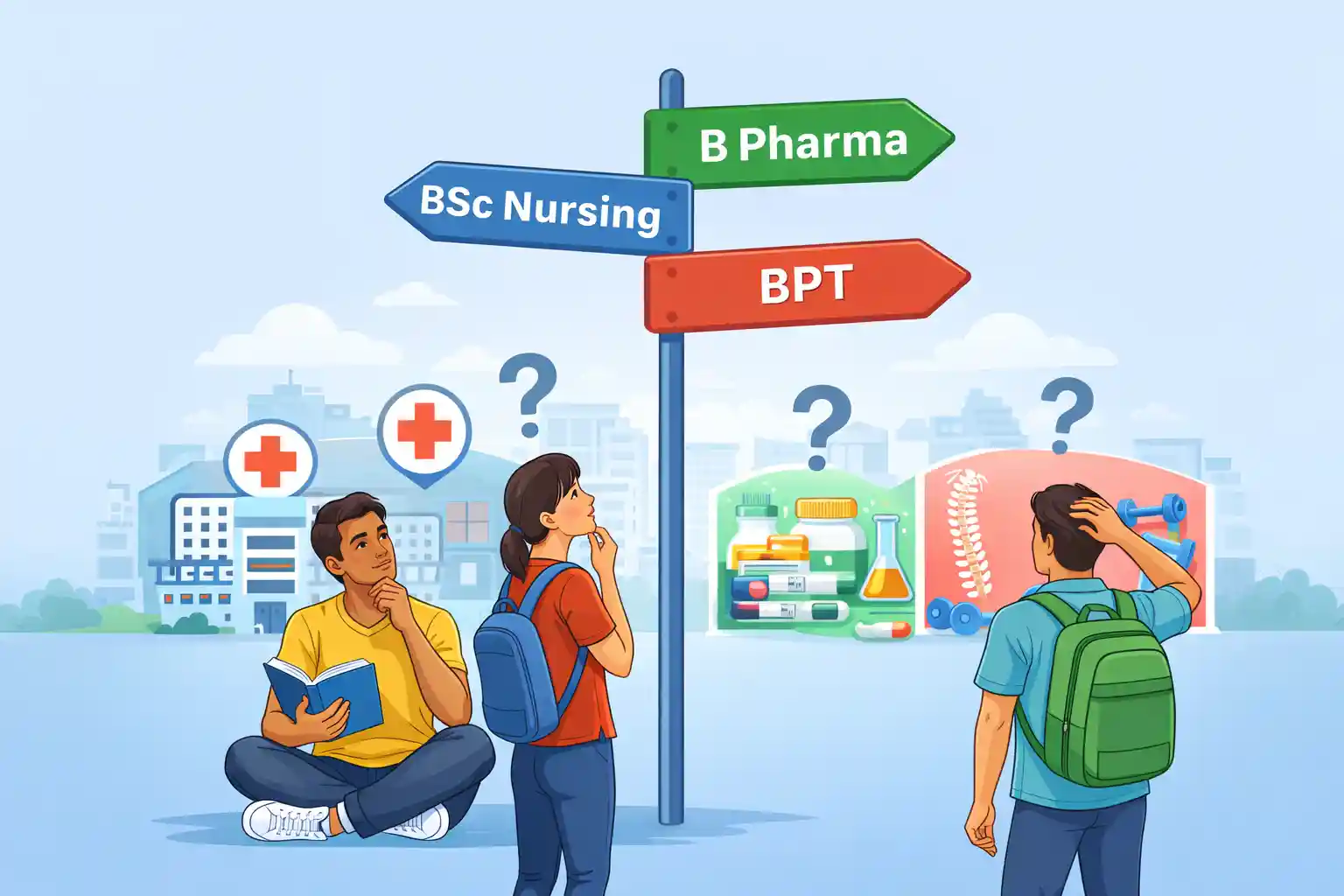
For a student finishing Class 12 with PCB who does not want to take the MBBS route, three degrees keep coming up — BSc Nursing, B Pharma and BPT. All three are part of the healthcare field, all three lead to growth-oriented and stable careers, and all three are worth considering. The fact is that each one of the three disciplines suits very different kinds of people depending on their nature and interests. The daily work routine, type of work, working hours, the environments and the long-term career paths are quite different in each one of them. This guide compares them with honesty — the course, the eligibility, the fees, the roles, the scope abroad and above all, which discipline is best suited to which kind of person — so that you choose your discipline as per your nature and interests rather than which one of them sounds fascinating.
In short: BSc Nursing, B Pharma and BPT are three PCB-centric healthcare degrees that exclude the MBBS route. Nursing (4 years) is hands-on patient care with the strongest government and overseas demand; B Pharma (4 years) is a science-and-industry career in medicines, with no NEET at most colleges; and BPT (4.5 years, with a 6-month internship) is movement and rehabilitation work that leads to well-paid private practice. The right choice depends far more on the daily work routine and type of work you prefer.
BSc Nursing vs B Pharma vs BPT — at a Glance
The fees are indicative for 2026 and will vary by college, city and category — government institutes’ fees are almost always among the lowest, and private ones may be average to high depending on the institute, location, campus recruitment records, etc. You need to confirm the current actual figures with the institute itself and the relevant council (INC, PCI, NCAHP).
| BSc Nursing | B Pharma | BPT |
Duration | 4 years | 4 years | 4.5 years, including a 6-month internship |
Eligibility | 10+2 with PCB; NEET accepted or required at most government colleges, with some institutes running their own entrance | 10+2 with PCB; mostly merit-based or via state pharmacy entrances (GPAT, MHT-CET, WBJEE-Pharmacy); no NEET | 10+2 with PCB; largely merit-based on Class 12 marks; some institutes (e.g. CMC Vellore) hold their own test; no NEET at most colleges |
Fees | Government institutes among the lowest; private institutes average to high, depending on the institute and location | Government institutes among the lowest; private institutes average to high, depending on the institute and location | Government institutes among the lowest; private institutes average to high, depending on the institute and location |
Typical roles / scope | Staff nurse and clinical roles in hospitals and government health services (AIIMS, ESIC, railway hospitals); strong overseas demand after licensing (UK, Canada, Australia, Germany, Gulf) | Production, quality assurance, regulatory affairs, research and marketing across the pharmaceutical industry | Physiotherapist in hospitals and rehab centres, across orthopaedic, neurological, cardiopulmonary and sports physiotherapy; strong scope for independent private practice |
What Each Degree Actually Involves
BSc Nursing
BSc Nursing is a four-year degree course built around patient care, clinical training and healthcare management, with a great deal of hospital exposure throughout. You study anatomy, physiology, microbiology and pharmacology, alongside the mandatory clinical rotations in medical-surgical, paediatric, obstetric and psychiatric nursing. That hands-on practical grounding is the reason nursing graduates are job-ready on the day they finish their course — and their job is no doubt demanding, shift-based, emotionally involved work, spent with people at their most vulnerable time. Alongside the skill and knowledge, a genuine passion to serve people and care for them during their time of distress and ailment is equally important.
B Pharma (Bachelor of Pharmacy)
B Pharma is a four-year degree centred on medicines — pharmaceutical chemistry, pharmacology, pharmacognosy, pharmaceutics and drug regulatory affairs — rather than on direct patient care. B Pharma graduates move into production, quality assurance, regulatory work, research or marketing across the pharmaceutical industry. It suits an analytical, detail-oriented student, someone drawn to science and technology on the human application side.
BPT (Bachelor of Physiotherapy)
BPT is a four-and-a-half-year degree, which includes a six-month internship, and it is focused on movement, rehabilitation and recovery. You study biomechanics, exercise and electrotherapy, and rehabilitation science, with clinical training across orthopaedic, neurological, cardiopulmonary and sports physiotherapy. It is hands-on and patient-facing in the way nursing is, but centred on helping people recover their function — and it lends itself, over time, to independent private practice.
Job Stability, and Where the Work Is
All three are on solid ground, but the shape of the security is different in each. Nursing currently offers the most structured government route, since staff-nurse posts come up regularly through AIIMS, ESIC, the railway hospitals and the state health departments, and India's low nurse-to-patient ratio keeps the demand high. Pharmacy offers its stability through a regulated, industry-wide career, with clear corporate ladders in production, quality assurance and regulatory affairs. Physiotherapy trades some of that structure for flexibility, because while hospitals and rehab centres do employ physios, the field also rewards specialisation and private practice, where you build up your own base over time. All three are established, in-demand healthcare fields with steady long-term demand.
Earning Trajectory — an Honest Comparison
Rather than quote figures that swing wildly from one city, employer and year to the next, here is the honest relative picture. Pharmacy tends towards the highest structured corporate pay, especially in the multinational companies and in the specialised regulatory or R&D roles. Nursing offers steady, dependable income at home, along with notably strong earning potential once you are licensed to work abroad, plus the benefits that come with government roles, like a pension and housing. Physiotherapy usually starts more modestly in salaried work, but it can climb well through specialisation and, above all, through a successful private practice. In short, it is pharmacy for the corporate ceiling, nursing for stability plus the overseas option, and physiotherapy for independence and long-run upside. In every one of them, it is better to treat pay as something that grows with your skill and specialisation than a fixed number attached to the degree.
The Scope Abroad
The global shortage of healthcare workers makes all three exportable, though not equally so. Nursing has the strongest and clearest overseas demand — the UK, Canada, Australia, Germany and the Gulf actively recruit Indian nurses once they have cleared a licensing exam such as NCLEX in the US, CBT or OSCE in the UK, or DHA, DOH Abu Dhabi or MOH in the UAE, and several of these countries offer residency pathways too. Physiotherapy comes next, through skilled-migration programmes in Australia, Canada, the UK and New Zealand, after country-specific licensing. Pharmacy travels as well, but international clinical practice usually calls for an added qualification, such as an MPharm or a country registration, while the multinational pharma companies open up another route by way of corporate transfers. If working abroad is a priority for you, nursing is the most direct path to it.
Admission and Entrance Exams
All three ask for 10+2 with Physics, Chemistry and Biology. Beyond that:
- BSc Nursing — NEET is now accepted or required at most government nursing colleges, while some institutes run their own entrance followed by counselling. The age requirement is typically 17 or above, with a medical-fitness and character check.
- B Pharma — admission is mostly merit-based, or through the state pharmacy entrances such as GPAT, MHT-CET or WBJEE-Pharmacy, with centralised counselling for government and private seats.
- BPT — admission is largely merit-based on your Class 12 marks, though the reputed institutes, such as CMC Vellore, conduct their own tests.
Keep track of the official notifications, and start your applications early for the next academic year.
Which One Fits You?
Because all three lead to respectable, stable healthcare careers, the deciding factor is not status — it is temperament. And this is where students most often choose wrongly, picking the degree a cousin took or the one that sounded most impressive, rather than the one that matches how they are actually built. So be honest with yourself about the kind of work you want:
Choose BSc Nursing if you value job stability and a structured path, if you want strong overseas demand and immigration routes, if you are drawn to hands-on patient care, and if you can handle shift work and emotionally demanding situations.
Choose B Pharma if you prefer analytical, lab-based and industry work without direct patient contact, if you want flexibility across research, regulatory work, management and business, and if you are genuinely interested in the science and the commerce of medicines.
Choose BPT if you enjoy direct, hands-on rehabilitation work, if you want the independence that private practice offers, if you are drawn to sports medicine and recovery science, and if you have the stamina and the patience for long-term patient care.
If more than one of those descriptions sounds like you — and for plenty of students, it genuinely does — that's precisely where a proper career assessment becomes useful. A scientifically proven psychometric assessment reads your interests, strengths, abilities and personality, and points to which of the three environments — the ward, the lab or the rehab clinic — actually suits you, before four years and a considerable sum of money are committed. That's the gap our career guidance programs at Global Career Labs are designed to close, backed by a session with a senior career counsellor to walk through what the results mean for you.
Frequently Asked Questions
Is a B.Sc Nursing degree better than a B.Pharm degree?
Neither is universally better — they suit different people. Nursing leads on job stability, government roles and overseas demand; B Pharma leads on structured corporate and industry growth in medicines. The right one depends on whether you prefer hands-on patient care or a science-and-industry career.
Is BPT better or B Pharma?
Neither is better in the abstract. BPT (physiotherapy) offers independent practice, specialisation and more flexible hours, and usually avoids night shifts; B Pharma offers a more structured route into the pharmaceutical industry, research and retail. Choose by the kind of daily work you want.
Who earns more, BPT or a nurse?
Early salaried pay is broadly comparable and fairly modest for both. Nursing earns strongly once you are licensed to work abroad and carries government pay and security at home; physiotherapy can climb well through specialisation and private practice but usually starts slower. Because the ranges overlap and shift by city and role, choose by fit rather than a monthly figure.
Which is better, B.Sc Nursing or physiotherapy?
Both are strong healthcare degrees for different temperaments. Nursing suits those drawn to direct patient care, hospital and overseas roles, and job security; physiotherapy suits those drawn to rehabilitation, sports or neuro specialisation and eventual independent practice. Neither is better — it depends on the work you want to do.
Is BPT a high-paying job?
Physiotherapy starts modestly on a salary, but it has real long-term upside: through specialisation in sports, neuro or orthopaedic physiotherapy and through private practice, experienced physiotherapists can earn well and with more independence than a salaried hospital role. So it is less about a high starting salary and more about how far you build the career.
Which is better, paramedical or B Pharma?
They overlap but differ in scope. "Paramedical" covers a range of allied-health diplomas and degrees — lab technology, radiology, physiotherapy, nursing aides — that get you into healthcare roles, sometimes faster; B Pharma is a focused four-year degree into the pharmaceutical and medicines industry. Choose paramedical for a broad, quicker allied-health entry and B Pharma for a pharmacy-specific career.
Deciding, With a Little Help
Feeling genuinely torn between the three is not a bad sign — it usually means you are taking the choice seriously, and that is exactly where some honest guidance helps. A scientifically proven career assessment can tell you whether hands-on care, analytical lab work or rehabilitation fits you best, and a one-to-one conversation with a senior career counsellor from Global Career Labs turns that reading into an actual plan. Take a look at our career guidance programs, or browse our wider guide to healthcare courses after 12th. The goal throughout is simply to help you find the path that's genuinely right for you.
Related Readings
- Medical Courses After 12th Without NEET
- Nursing Course After 12th
- Engineering vs Medical After 12th
- Courses After 12th: Options Across Every Stream