Career Options After 10th: Streams, Diplomas, ITI and How to Choose
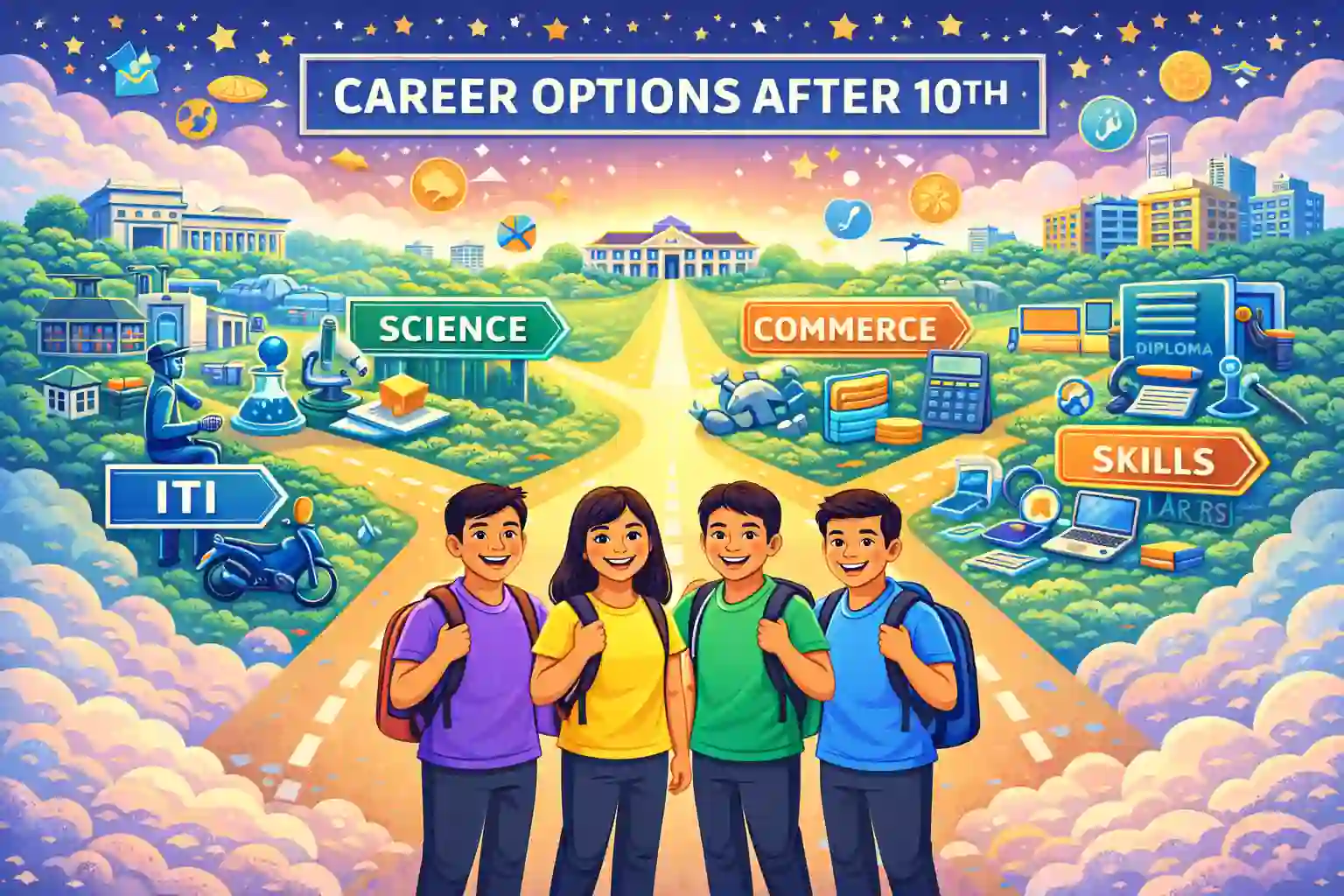
Finishing Class 10 brings the first career decision which really shapes your future — and you have to make it at the age of fourteen or fifteen, often under situational and family pressures. The good news is that today there are more good career paths than before. This article lays out the career options after 10th one by one: the three streams for Class 11, diplomas and polytechnic, ITI trades, vocational and skill courses, and specialised routes — and then, most importantly, how you can choose the one which fits you rather than the one everyone else is chasing.
In short: After Class 10 you can continue to Class 11 in science, commerce or arts; join a 3-year polytechnic diploma; learn a trade at an ITI in 6 months to 2 years; or take a vocational or skill course. Each path keeps different doors open. The right choice depends on your strengths, interests and goals — not on what friends choose or which option sounds most prestigious.
The Main Career Paths After 10th at a Glance
There are four broad paths after Class 10, and each one leads somewhere different.
| Path | Duration | Where it leads | Suits you if… |
| Class 11–12 (science, commerce or arts) | 2 years, then a degree | Degrees, professional courses, competitive exams | You are ready for 5 to 7 more years of study before working |
| Polytechnic diploma | 3 years | Junior engineer and technician jobs, or B.Tech through lateral entry | You like technical, hands-on learning |
| ITI trade | 6 months to 2 years | Skilled trades, apprenticeships, self-employment | You want a practical skill and an early start to earning |
| Vocational and skill courses | A few months to 1 year | Entry-level jobs in services, IT and healthcare support | You want a quick, focused skill alongside or instead of further study |
None of these is a lesser choice. A well-chosen ITI trade can lead to a more secure career than a stream picked under pressure, and many students combine paths — for example, finishing Class 12 through open schooling while learning a skill.
Option 1: Choosing a Stream for Class 11
Most students continue to Class 11, where the stream you choose decides which entrance exams and degree courses stay open to you.
- Science (PCM or PCB): engineering, medicine, pure sciences, data science, architecture and allied healthcare. PCM keeps technical and Maths-based careers open; PCB leads towards medicine and life sciences.
- Commerce: chartered accountancy, banking, business, management, economics and law. Taking Maths in commerce keeps more doors open later.
- Arts / Humanities: law, psychology, journalism, design, teaching, the civil services and social sciences — a far wider field than its old reputation suggests.
Within each stream, your subject combination matters too. Our articles on the best stream after 10th and on subject combinations go into that choice in detail.
Option 2: Polytechnic Diploma After 10th
A polytechnic diploma is a 3-year technical course which you can join straight after Class 10, usually through a state polytechnic entrance test or merit.
Diplomas cover branches such as civil, mechanical, electrical, electronics and computer engineering. They lead to roles such as junior engineer, technician or supervisor, and diploma holders can later join the second year of a B.Tech through lateral entry, where seats are available. Government polytechnics keep fees low. For the full picture, see our article on polytechnic after 10th and our list of diploma courses after 10th.
Option 3: ITI Trades After 10th
An ITI (Industrial Training Institute) teaches a specific trade through mostly practical training, in courses which run from 6 months to 2 years under the Directorate General of Training.
Popular trades include electrician, fitter, welder, plumber, mechanic and computer operator. Newer trades follow the industries which are growing now: for example, Mechanic Electric Vehicle is a 2-year trade and Drone Technician a 6-month trade. After an ITI, you can work, join an apprenticeship, start your own small business, or continue to a diploma. Our article on ITI courses after 10th explains the trades and how to choose one.
A Closer Look at a New ITI Trade: Solar Technician (Electrical)
Solar Technician (Electrical) is a one-year ITI trade under the Craftsmen Training Scheme, open to students who have passed Class 10. Its official curriculum shows how the newer trades are built.
| Detail | What the official DGT curriculum says |
| Duration | One year: 1,200 hours of training plus 150 hours of on-the-job training or a group project |
| Level | NSQF Level 3 |
| Entry qualification | Passed Class 10; minimum age 14 on the first day of the session |
| Training split | 840 hours of trade practical, 240 hours of trade theory and 120 hours of employability skills |
| Certificate | National Trade Certificate (NTC), awarded by DGT |
| Job roles | Solar panel installation technician; solar PV system installation technician |
The training covers basic electrical laws, measuring solar radiation, photovoltaic cells and modules, batteries, charge controllers and inverters, and the installation, testing and maintenance of solar PV plants.
The curriculum also lists clear next steps:
- Work as a technician and grow into senior technician, supervisor and manager roles.
- Start your own business in the field.
- Join an apprenticeship which leads to a National Apprenticeship Certificate (NAC).
- Train as an ITI instructor through the Crafts Instructor Training Scheme (CITS).
- Go on to an advanced vocational diploma under DGT.
Fees, seats and admission dates vary by state and institute, so check your state's ITI admission notice before you apply.
Apprenticeships: Learning While You Earn
An apprenticeship lets you train inside a real workplace and receive a monthly stipend while you learn. Under DGT's Apprenticeship Training Scheme, ITI pass-outs can join an industry apprenticeship which ends with a National Apprenticeship Certificate (NAC).
For a student who wants to start earning early without giving up on learning, an ITI trade followed by an apprenticeship is one of the most practical routes after Class 10. You build workplace experience, a recognised certificate and contacts in your industry, which often matter as much as marks when you look for your first job. Openings are listed on the government's apprenticeship portal, and many employers prefer candidates who have already completed an ITI trade.
Option 4: Vocational, Skill and Specialised Courses
Vocational and skill courses teach job-ready skills quickly, often in a few months to a year.
- Healthcare support: paramedical and allied health courses such as lab assistance and patient care — see our article on paramedical courses after 10th.
- Commerce and office skills: accounting software, data entry and office management — see commerce courses after 10th.
- Creative and digital skills: graphic design, photography and basic digital marketing.
- Specialised routes: the merchant navy, agriculture and others which begin after Class 10 — our merchant navy courses after 10th article covers one of them.
If you choose a skill course, you do not have to give up formal education. Open schooling through the National Institute of Open Schooling (NIOS) lets you complete Class 12 at your own pace while you learn or work.
Future-Ready Careers to Know About After 10th
Some of the fastest-growing fields can be reached through more than one of the paths above, which gives you flexibility. Thinking ahead about where your interests point helps you choose a path which still makes sense ten years from now.
- Technology and data — through science with Maths, a computer engineering diploma or an IT-related ITI trade.
- Electric vehicles and clean energy — through electrical or mechanical diplomas, or ITI trades such as Mechanic Electric Vehicle and Solar Technician (Electrical).
- Healthcare — through science with Biology, or allied health and paramedical routes.
- Design and digital media — through any stream, plus portfolio-based courses.
- Finance and business services — through commerce, with Maths for the widest choice.
Honestly, no field is "future-proof" on its own; what lasts is a good fit between your abilities and the work, plus a habit of learning new skills.
How to Choose the Right Career Path After 10th
Choose your path after 10th by starting with yourself — your strengths, abilities, aptitude and interests — and only then matching them to a stream, course or trade.
- Understand your strengths. Which subjects come easily, and which kinds of problems do you enjoy solving?
- Know your interests. Do you like working with machines, people, numbers, ideas or creative work?
- Think about your goals. Do you want to start earning soon, or are you ready for a long study path towards a specialised profession?
- Check the practical side. Fees, the distance to a good college or institute, and your family's circumstances all matter.
- Get evidence and advice. A proper assessment and a conversation with a trained counsellor turn guesswork into a decision.
The most common mistakes are choosing a stream because friends chose it, choosing science by default because it "keeps options open", and ignoring the trades and diplomas which suit hands-on learners far better. Our career chart after 10th maps where each path leads, step by step.
Popular Careers and the Path From Class 10
For many students, the easiest way to choose is to work backwards from a career. The table shows the usual route for some popular choices.
| Career | Path after Class 10 | Usual next step |
| Doctor | Science with Biology (PCB) | NEET-UG after Class 12, then MBBS |
| Engineer | Science with Maths (PCM), or a polytechnic diploma | JEE Main or a state test, then B.Tech; diploma holders through lateral entry |
| Chartered Accountant | Commerce, ideally with Maths | CA Foundation, then the Intermediate and Final levels of ICAI |
| Lawyer | Any stream | CLAT or another law entrance test, then a five-year integrated LLB |
| Designer | Any stream | Design entrance tests such as NID DAT or UCEED, then a design degree |
| Civil services officer | Any stream | Any bachelor's degree, then the UPSC Civil Services Examination (minimum age 21) |
| Skilled technician | An ITI trade | An apprenticeship, a job, or a diploma through further study |
Career Options After 10th for Different Situations
The right option also depends on your situation. Here is how the choices change in some common cases.
- If you do not enjoy Maths: arts, commerce without Maths, and many vocational and healthcare-support courses keep good careers open; law, psychology, design and journalism do not need Maths after Class 10.
- If your marks are average: marks are only one signal. A diploma, an ITI trade or a skill course where you learn by doing can suit you better than forcing a stream, and many students do far better once the learning becomes practical.
- If you need to start earning early: an ITI trade followed by an apprenticeship is the most direct route, because you receive a stipend while you train.
- For girls: every stream, diploma and trade is open, and the Directorate General of Training runs National Skill Training Institutes for women, while many states run ITIs for women.
Government Jobs and Class 10: What Is Realistic
Several government recruitments accept a Class 10 pass, but most of them also need you to be at least 18. For a student who finishes Class 10 at fifteen or sixteen, they are a later step rather than an immediate option.
Examples include the Staff Selection Commission's Multi-Tasking Staff exam for central government offices, entry-level posts in the railways, and soldier-level entries in the armed forces and police, each with its own age limits and conditions. Continuing your education or learning a trade keeps these doors open and adds many more, so use the next two years to build a qualification rather than simply waiting. Our article on government jobs in India sets out the main options.
Common Myths About Career Options After 10th
Several common beliefs push students towards the wrong choice at this stage. Here are the ones counsellors hear most often.
- "Science keeps every door open." It keeps many doors open, but only if you can cope with the subjects. A student who struggles with science for two years often ends up with fewer options, not more.
- "ITI is only for weak students." ITI trades are skilled, certified work in growing fields such as electric vehicles and solar energy, and they can lead to a diploma, an apprenticeship or your own business.
- "Arts has no scope." Law, psychology, design, journalism, economics and the civil services all begin comfortably from the arts stream.
- "A diploma closes the door to a degree." Diploma holders can join the second year of a B.Tech through lateral entry, where seats are available.
- "The stream decision is final." Many graduates change direction after Class 12 — a science student can study commerce or arts at university — though the change is easier when the first choice is made well.
A Simple Timeline for Class 9 and 10 Students
A good decision after 10th is rarely made in the week the results come out. A calmer timeline looks like this:
- Class 9: notice which subjects you enjoy and which come easily, and talk to people who work in fields which interest you.
- Early Class 10: take a proper career assessment and discuss the results with your parents and a counsellor.
- Before the board exams: shortlist your stream or course and note the admission or entrance dates which apply to you.
- After the results: apply on time — Class 11, polytechnic and ITI admission dates vary from state to state, so check your state's notices early.
Career Guidance After 10th — and the Role of Parents
Career guidance after 10th works best as a partnership between you, your parents and a trained counsellor. At this age, parents know you well, but they may also carry hopes of their own; a neutral, evidence-based view helps everyone agree on a choice which suits you.
In a GCL counselling session at this stage, the counsellor usually starts by separating the student's own interests from the family's expectations, and then checks both against the student's aptitude. When the three line up, the decision becomes easy; when they do not, that is where the most useful conversation happens.
At Global Career Labs, this begins with a scientifically proven assessment which measures your interests, strengths, abilities and personality. A senior career counsellor from Global Career Labs then goes through your personalised career report with you and your parents and turns it into a career plan: your best-fit stream and subjects or the right diploma or trade, a future-ready education plan and the career path which is the best alignment for your talents. If this is done at an early age, it saves time, money and a great deal of undue stress. Our article on the aptitude test for students explains how the assessment works, and our career guidance programs page shows the options for Class 8 to 10. You can also Contact GCL's Career Advisor to talk it through first.
Frequently Asked Questions About Career Options After 10th
Which career is best after 10th?
There is no single best career after 10th — the right path depends on your interests and strengths. The main routes are choosing a stream (Science, Commerce or Arts) towards a degree, a polytechnic diploma or ITI for quicker technical jobs, or paramedical and vocational courses. The best one is the path that fits how you think and what you enjoy.
Which course is best after 10th?
It depends on your goal. For a degree route, pick the 11th and 12th stream that matches your target career; for faster employment, a polytechnic diploma, ITI trade or paramedical course gets you skilled and earning sooner. There is no universally best course — choose by fit, ideally with an aptitude check.
How can I earn Rs 30,000 per month?
After Class 10, reaching around Rs 30,000 a month usually takes a recognised skill and some experience — for example a skilled trade after an ITI, a technician role after a polytechnic diploma, or a government post through a recruitment exam. Pay depends on the trade, city and employer, so treat it as a target that builds over a few years rather than a starting salary.
Which vocational course is best after 10th?
It depends on the kind of work you enjoy. Common choices are ITI trades such as electrician, fitter or mechanic, polytechnic diplomas in engineering, computer applications, and skill courses in hospitality, beauty and wellness, retail or automotive service. Choose one that is properly recognised (NCVT or SCVT for ITI, a state technical board for diplomas, or a Skill India certificate) and that leads to a clear job role.
Which job is best for a 10th pass?
After 10th, common paths to a job are ITI trades (electrician, fitter, COPA), polytechnic diplomas leading to technician and junior-engineer roles, paramedical and vocational courses, and some government posts that accept a 10th pass. Starting here lets you earn early and upgrade later through lateral entry or further study.
Which course after 10th has the highest salary?
Higher-earning routes usually need more study, but among post-10th options polytechnic engineering diplomas and skilled ITI trades in strong demand (like electrician or CNC), plus paramedical courses, tend to lead to the better pay over time. Salary grows with skill and experience, so treat any single figure as indicative.
The Right Path Is the One Which Fits You
After Class 10 there is no single "best" career option — there is the path which fits your strengths, interests and goals. Streams, diplomas, ITI trades and skill courses can all lead to secure and fulfilling careers when they are chosen for the right reasons. Take the time to understand yourself, involve your parents, and get guidance before you decide. If you would like a senior career counsellor from Global Career Labs to help, with a scientifically proven assessment behind the decision, start with our career guidance programs.
Related Readings
- Best Stream After 10th
- Career Chart After 10th
- ITI Courses After 10th
- Polytechnic After 10th
- Career Guidance for Parents
Official Resources
- Directorate General of Training (DGT), Ministry of Skill Development and Entrepreneurship — dgt.gov.in
- DGT curriculum for the Solar Technician (Electrical) trade (PDF)
- Apprenticeship India portal — apprenticeshipindia.gov.in
- National Institute of Open Schooling (NIOS) — nios.ac.in
- AICTE — All India Council for Technical Education
- National Career Service (NCS), Ministry of Labour & Employment — ncs.gov.in
- Skill India Digital (MSDE) — skillindiadigital.gov.in